

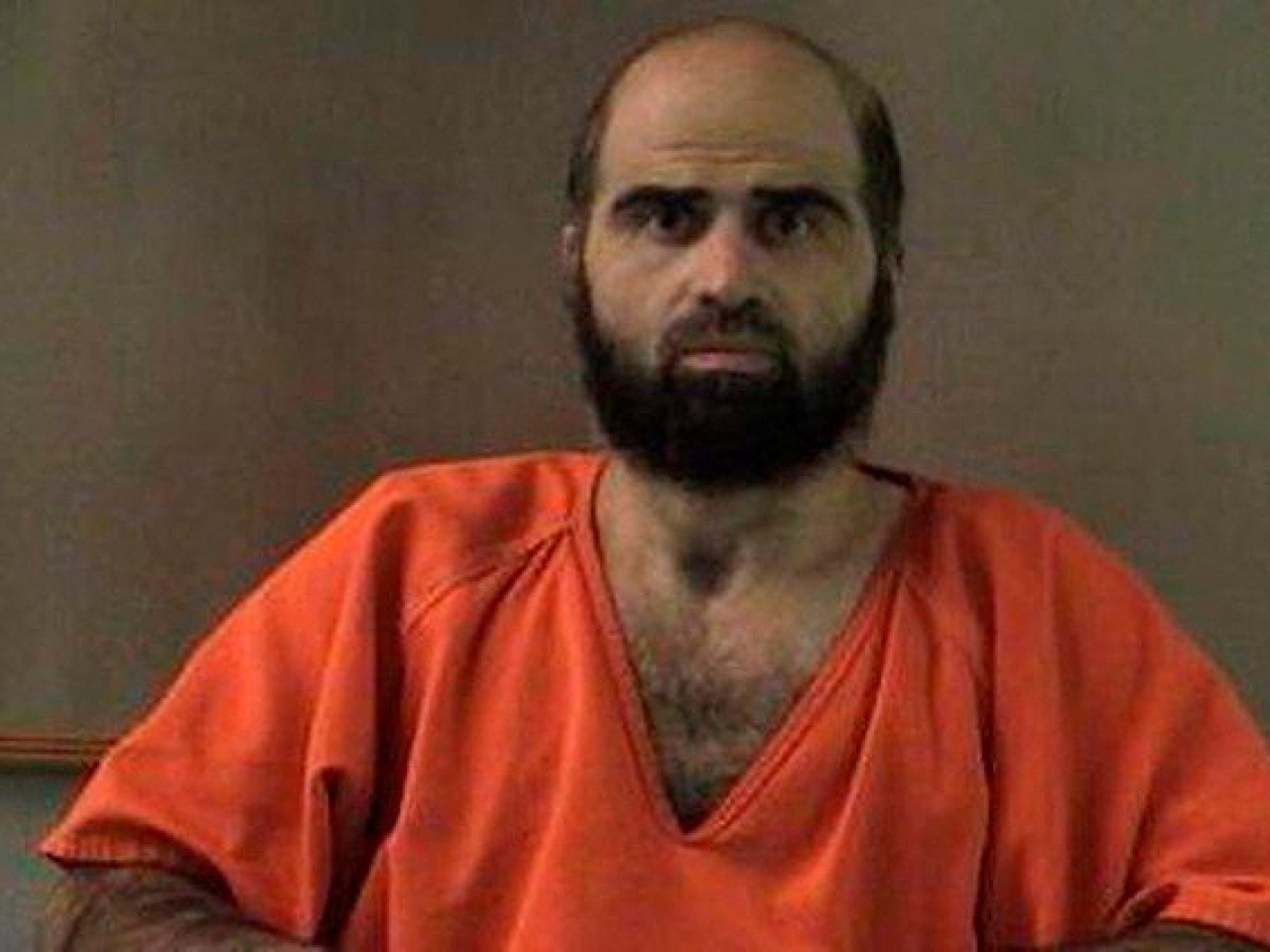
President Donald Trump has approved the execution by firing squad of former US Army psychiatrist Nidal Malik Hasan, who was convicted of killing 13 people and wounding 32 others during the 2009 mass shooting at Fort Hood, Texas.
The decision, announced by the Pentagon on Monday, could revive military executions in the United States after a 65-year gap. If carried out, Hasan would also become the first US military prisoner executed by firing squad since Army Pvt. Eddie Slovik was shot by a firing squad in France in 1945.
Defense Secretary Pete Hegseth recommended the execution method, and Trump approved it. Pentagon spokesman Sean Parnell announced the decision on social media, saying the Secretary of the Army would determine the time and location of the execution.
No execution date has yet been announced.
The case is unusual not only because of the method chosen but also because of the long history of Hasan's death sentence. A military jury sentenced him to death in 2013, but years of mandatory military appeals and later federal litigation prevented the sentence from being carried out.
What happened at Fort Hood?
Hasan opened fire on November 5, 2009, inside a medical processing facility at Fort Hood, a major US Army installation in Texas that served as a staging point for troops preparing to deploy to Iraq and Afghanistan.
Soldiers were undergoing final medical checks when Hasan began shooting. He pursued people as they tried to escape and was eventually confronted by responding officers.
Thirteen people were killed in the attack, including 12 soldiers and one civilian employee. Another 32 people were wounded.
The shooting lasted only minutes, but its impact was felt throughout the US military. Fort Hood was one of the country's largest military installations, and many of the people inside the processing centre were preparing to leave for combat zones.
Hasan, who was an Army major and psychiatrist, was shot during the confrontation with police. He survived but was left paralysed from the waist down and has since used a wheelchair.
The attack immediately triggered questions about Hasan's motives, his contacts and his views about the wars in Iraq and Afghanistan.

Hasan admitted he carried out the shooting
Hasan did not seriously contest the central facts of the case during his 2013 court martial.
He represented himself during the trial and did not call witnesses or testify in his own defence. His court appointed lawyers had expressed concern that he was deliberately seeking a death sentence rather than trying to avoid it.
Military prosecutors argued that Hasan had planned the attack and deliberately targeted fellow service members.
During the proceedings, Hasan said he had been motivated by opposition to US military operations in Muslim countries. He told the court that he was targeting soldiers who were preparing to deploy to Afghanistan and argued that he wanted to protect Taliban fighters and leaders from American forces.
Hasan was convicted of 13 counts of premeditated murder and 32 counts of attempted murder. A panel of 13 military officers unanimously recommended the death penalty.
His conviction and sentence later went through multiple stages of review.
Military appeals courts upheld the sentence, and the US Supreme Court declined to take up his case in 2025, leaving the death sentence in place.
Hasan is currently held at the US Disciplinary Barracks at Fort Leavenworth, Kansas, the military's maximum security prison.
Links to radical cleric examined during trial
The court also heard evidence about Hasan's views on the US wars in Iraq and Afghanistan and his communications with Anwar al-Awlaki, an American-born cleric who was later described by US authorities as an al-Qaeda propagandist.
Awlaki was killed in a US drone strike in Yemen in 2011.
The relationship became part of the wider investigation into Hasan's radicalisation and the thinking behind the Fort Hood attack. Prosecutors presented evidence that Hasan had communicated with Awlaki before the shooting.
Hasan had also expressed opposition to the wars and concerns about American military operations involving Muslim countries.
Those views formed part of the prosecution's account of his motive, while Hasan himself openly acknowledged that he was the gunman.
Why a firing squad?
The choice of a firing squad makes Hasan's case particularly unusual in the history of US military executions.
The US military has not executed a service member since 1961, when Army Pvt. John Bennett was hanged at Fort Leavenworth after being convicted of raping and attempting to murder an 11-year-old Austrian girl.
But the last US military execution by firing squad took place much earlier.
Army Pvt. Eddie Slovik was executed by firing squad on January 31, 1945, in France after being convicted of desertion during World War II.
Slovik remains the only US service member known to have been executed for desertion during World War II. His case later became one of the most controversial military executions in American history.
Unlike Hasan, Slovik's offence was not murder. His execution was tied to military discipline during a period when American forces were fighting across Europe.
The difference is significant: Hasan's planned execution would be the first US military firing-squad execution in more than eight decades, while the broader military death penalty has been unused since 1961.
Military executions are extremely rare
Military courts can impose the death penalty for certain serious offences, including premeditated murder. But the process differs from ordinary civilian death penalty cases.
Presidential approval is required before a military death sentence can be carried out.
According to the Death Penalty Information Center, the US military has executed more than 100 service members during its history. Most military executions took place during earlier periods, particularly around World War II.
The last military execution, John Bennett's hanging in 1961, came more than six decades ago.
Hasan's case therefore represents a major departure from the modern pattern of military justice, in which death sentences can remain unresolved for many years without an execution taking place.
Three other prisoners are also on military death row at Fort Leavenworth.
Their cases involve separate murder convictions and have also remained tied up in lengthy legal proceedings.
Hasan may still challenge the execution
Trump's approval does not necessarily mean Hasan will be executed immediately.
The military justice system allows condemned prisoners to pursue further legal challenges, including petitions questioning the legality of their imprisonment or sentence.
Such proceedings can result in a stay of execution and potentially delay a death sentence.
The exact timetable will also depend on the Army's next steps. The Secretary of the Army is expected to establish the time and place of the execution under the military's procedures.
That means the Pentagon's announcement marks a major step toward carrying out the sentence, but it does not by itself establish the date on which Hasan will die.
The method, however, is now clear.
If the execution proceeds as approved, a US Army firing squad will carry out the sentence against the former psychiatrist whose 2009 attack at Fort Hood left 13 people dead and dozens more wounded.
The decision also brings back a method of military capital punishment that has been absent since the final months of World War II.
Do you think the US military should bring back firing squads for death sentences, or should executions use a different method?