

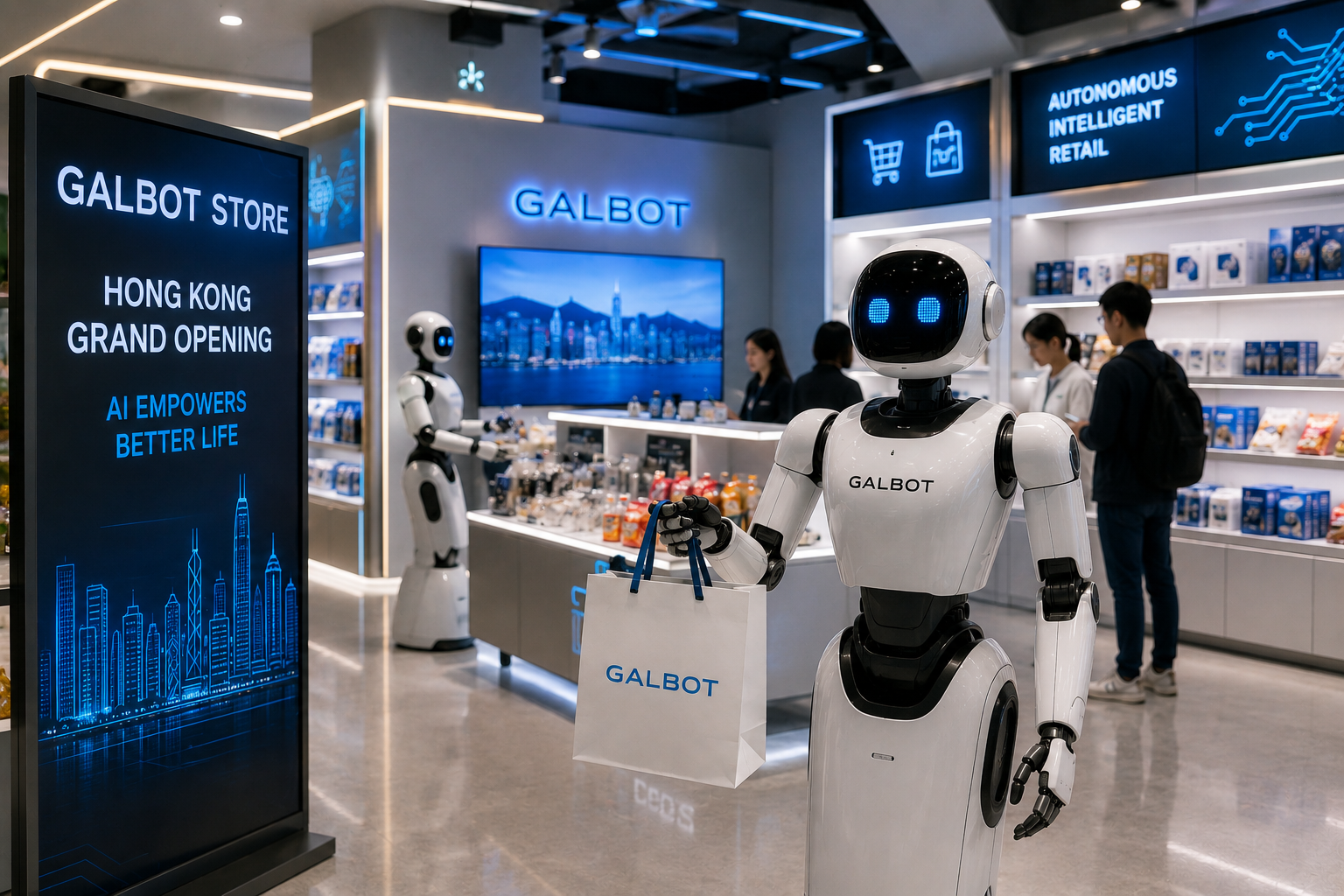
Chinese robotics company Galbot has opened three fully autonomous robot retail stores in Hong Kong, marking its first overseas expansion and giving the city a new commercial showcase for humanoid robotics and embodied artificial intelligence.
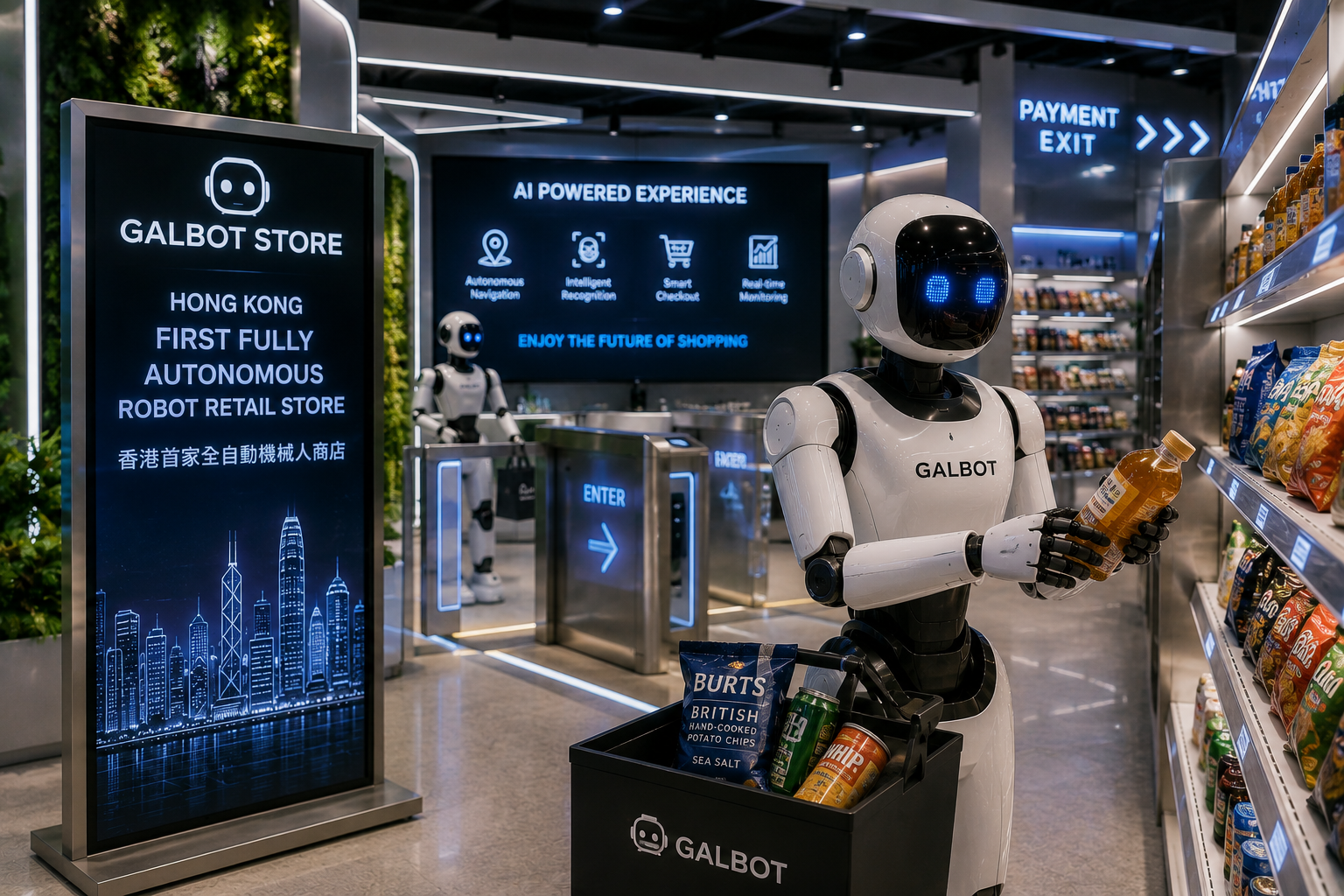
The three Galbot Stores, located in Hung Hom, Kai Tak and Wan Chai, were launched on Monday and are scheduled to open to the public on Tuesday. The outlets are the first fully autonomous robot retail stores of their kind in Hong Kong, according to the company.
The launch represents a move by Galbot from research and development into commercial operations while also giving the company a foothold outside the Chinese mainland. The Beijing based firm has already established a substantial retail network in mainland China, with about 200 stores operating across nearly 50 cities.
Wang He, Galbot’s founder and chief technology officer, said Hong Kong was an important part of the company’s international expansion plans.
Speaking at the launch ceremony, Wang said opening the first humanoid robot retail store in Hong Kong represented an important step as Galbot sought to turn technological development into practical applications.
He also said the company hoped to work with Hong Kong universities, research institutions and industry partners to establish laboratories focused on embodied artificial intelligence.
Such partnerships, Wang said, could help bring more technologies from the research stage into commercial use while also developing a new generation of talent in robotics and artificial intelligence.
Hong Kong becomes Galbot’s first overseas market
Galbot’s decision to open three stores in Hong Kong gives the company a direct presence in an international market at a time when humanoid robotics is attracting increasing investment and commercial interest.
The stores in Hung Hom, Kai Tak and Wan Chai place the company in three different parts of the city, providing opportunities to test its retail model across established commercial districts and newer development areas.
Unlike a conventional robotics showroom, the fully autonomous retail concept is intended to demonstrate how robots and artificial intelligence can operate in a commercial environment with limited human intervention.
The move also reflects a broader shift within the robotics industry. Companies that once focused mainly on laboratory research and demonstrations are increasingly seeking practical settings in which robots can interact with customers, handle retail tasks and operate as part of everyday commercial activity.
For Galbot, Hong Kong provides an opportunity to put that approach before an international audience.
The company has already built a network of about 200 retail outlets across almost 50 mainland cities. Its Hong Kong expansion therefore represents more than the opening of three individual stores. It is an early test of whether a retail model developed in mainland China can be adapted to a highly internationalised city with a dense population and a different consumer environment.
Paul Chan points to Hong Kong’s technology strengths
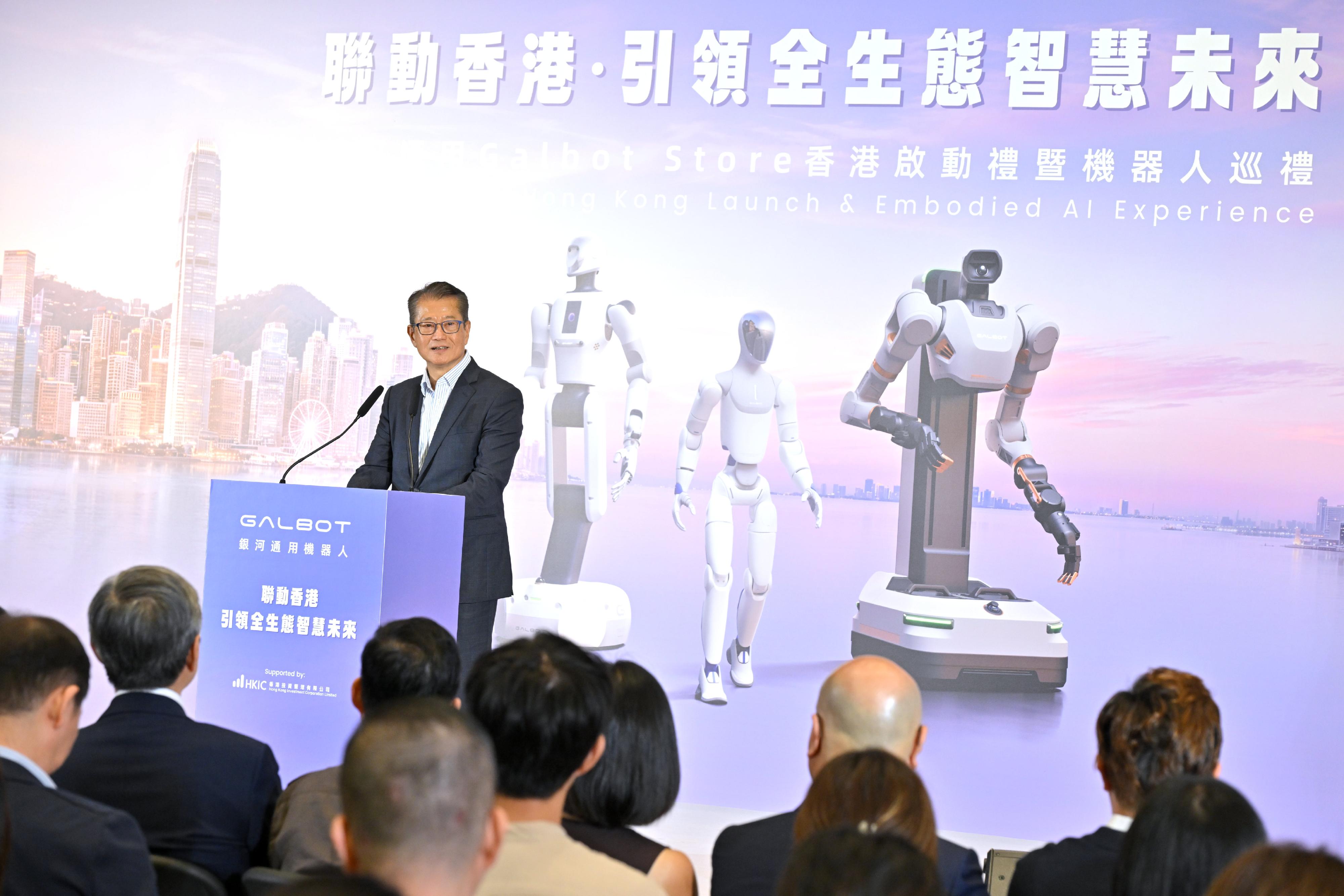
Hong Kong Financial Secretary Paul Chan Mo po said Galbot’s decision to establish its first overseas stores in the city reflected the characteristics of the local market.
Speaking at the launch ceremony, Chan pointed to Hong Kong’s dense population, diverse retail environment and international connections as factors that could make the city suitable for emerging robotics applications.
He said Hong Kong could play an important role as demand for humanoid robots grows worldwide, citing the city’s application market, research and development capabilities and access to capital.
The financial secretary also linked Hong Kong’s development as a technology centre with the wider Guangdong Hong Kong Macao Greater Bay Area.
He said the region could give Hong Kong a strong position in research, development and manufacturing for the next generation of embodied artificial intelligence.
The Greater Bay Area brings together Hong Kong, Macao and major mainland cities including Shenzhen and Guangzhou. The combination gives companies access to research institutions, manufacturers, supply chains and a large consumer market within a relatively concentrated geographic area.
For robotics companies, that combination can be particularly useful because commercialising advanced machines often requires more than software development. Robots need specialised components, manufacturing capacity, testing facilities, engineers and access to real world environments where their systems can be assessed.
Chan said Hong Kong’s intellectual property protection system, access to international data and pool of skilled workers were among the factors supporting its ambitions in this field.
Humanoid robotics market expected to expand
The Hong Kong launch comes as forecasts point to potentially enormous growth in the humanoid robotics industry.
Morgan Stanley has estimated that the global humanoid robotics market could exceed $5 trillion by 2050. The investment bank has also projected that more than 1 billion humanoid robots could be in use worldwide by that time.
China is expected to account for the largest share of that projected deployment, with an estimated 302.3 million humanoid robots potentially operating in the country.
Those projections help explain why robotics companies are moving beyond prototypes and demonstrations and looking for commercial applications.
Humanoid robots are being developed for a wide range of possible uses, including retail, manufacturing, logistics, healthcare and domestic services. Their human like physical form allows developers to explore machines that can perform tasks in environments designed around people rather than requiring businesses to redesign their facilities around specialised machinery.
The technology is still developing, however, and commercial success depends on whether robots can perform useful tasks reliably, safely and at a cost that businesses and consumers are willing to accept.
Retail stores provide companies with a visible environment in which those questions can be tested.
A store allows customers to interact directly with robotic systems and gives companies an opportunity to collect information about how people respond to machines in everyday settings.
HKIC has backed Galbot since 2024
Hong Kong’s ambitions in artificial intelligence and robotics are also supported by the city’s efforts to attract long term investment into emerging industries.
Chan pointed to the Hong Kong Investment Corporation Limited, a government owned investment organisation, as part of the city’s patient capital ecosystem.
The HKIC has been an investor in Galbot since 2024. Its backing places the robotics company among a group of technology businesses that have received support as Hong Kong seeks to strengthen its innovation and technology sector.
HKIC chief executive Clara Chan Ka chai said the corporation’s investment in companies such as Galbot had also helped connect those businesses with other long term investors, family offices and sovereign wealth funds internationally.
She said exposure to those investors could help technology companies expand their access to capital as they move from early development into commercial growth.
The HKIC has invested in more than 200 companies to date, with more than 70 percent of its capital directed towards startups and growing businesses.
For Galbot, the investment relationship with the HKIC predates the opening of its Hong Kong stores and provides a link between the company’s technology development and the city’s wider financial ecosystem.
From laboratories to commercial spaces
The opening of the three stores illustrates how the next stage of robotics development is increasingly taking place outside laboratories.
Research teams can demonstrate whether a robot can walk, recognise objects or manipulate items in controlled environments. Commercial stores present a much less predictable setting. Customers move differently, objects are placed in different positions and interactions happen without a fixed script.
That makes retail an important testing ground for embodied artificial intelligence.
Galbot’s proposed cooperation with universities and research institutions could further strengthen that connection between academic research and commercial applications. The company wants to establish embodied AI laboratories in Hong Kong and work with local industry partners.
For the city, such partnerships could create opportunities for researchers and students to work with commercially deployed robotic systems rather than limiting robotics research to academic settings.
The arrival of Galbot also adds another international dimension to Hong Kong’s technology sector. The city has spent recent years seeking to strengthen its position in artificial intelligence, advanced technology and innovation while using its financial system and links with the Greater Bay Area to attract technology businesses.
The three stores provide a tangible example of that strategy.
Customers will be able to encounter Galbot’s technology in a normal retail setting rather than at a technology exhibition or research facility. That change matters because the long term success of humanoid robotics will depend not only on what engineers can build, but also on whether people are willing to use, buy and work alongside the machines.
Galbot’s Hong Kong launch puts that question directly into the city’s commercial streets. Its three stores in Hung Hom, Kai Tak and Wan Chai will now serve as the company’s first overseas test of fully autonomous robot retail, while its planned partnerships with local universities and research institutions could determine how much of that technology develops further in Hong Kong.