

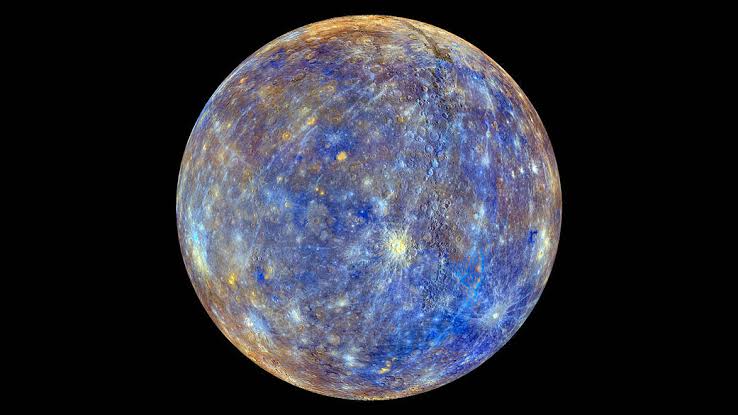
A new study led by researchers at The Chinese University of Hong Kong has challenged a long held explanation for the cliffs, ridges and wrinkles covering Mercury, suggesting that powerful activity deep inside the planet continued shaping its surface long after scientists expected it to have stopped.
The findings, published in Nature Communications, focus on Mercury’s Northern Smooth Plains, a huge volcanic region that covers about seven percent of the planet’s surface. Scientists had expected this relatively young terrain to show limited evidence of compression because most of Mercury’s global contraction was thought to have taken place before the plains formed.
Instead, the researchers found that the Northern Smooth Plains contain some of the strongest evidence of deformation anywhere on Mercury.
The discovery points towards a more complicated history for the planet’s interior. Rather than becoming geologically quiet after its early cooling period, Mercury appears to have experienced localised activity deep beneath its surface that continued to influence the crust over an extended period.
Mercury’s shrinking planet theory faces a challenge
Mercury is the smallest planet in the Solar System and the closest to the Sun. Its surface contains enormous cliffs, ridges and other structures that have long attracted the attention of planetary scientists.
For decades, researchers have largely explained these features through a simple process. Mercury formed as a hot rocky planet, and as its interior gradually cooled, the material inside contracted. That contraction placed the outer shell under compression, causing parts of the surface to buckle and produce cliffs and ridges.
The process resembles what happens when a cooling object contracts and its outer surface has to adjust to the reduction in volume beneath it.
Mercury’s surface provides strong evidence that this contraction occurred. Large fault scarps and ridges stretch across parts of the planet, showing where the crust was compressed as the planet became smaller.
The problem raised by the new study is timing.
If most of Mercury’s contraction happened early in its history, then geological regions that formed later should have experienced much less deformation. The Northern Smooth Plains appeared to fit that expectation until researchers examined the region in greater detail.
Their findings pointed in the opposite direction.
The Northern Smooth Plains tell a different story
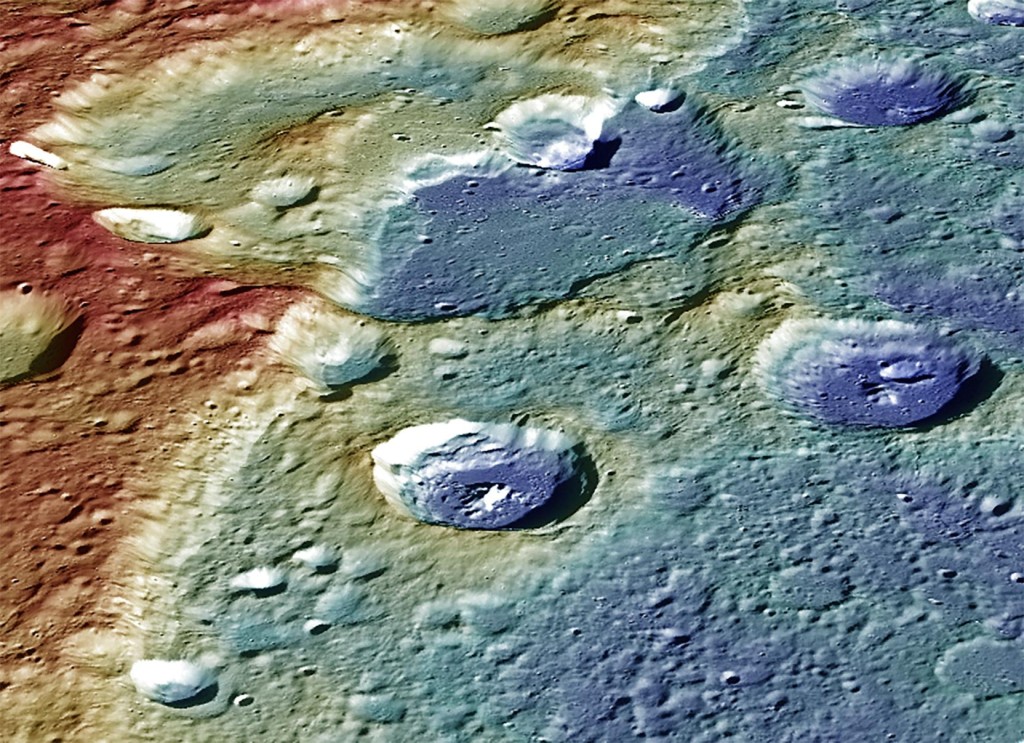
The Northern Smooth Plains are one of Mercury’s largest volcanic regions. Vast quantities of lava once spread across the area, creating a relatively smooth surface compared with many other parts of the planet.
Because the plains formed after much of Mercury’s early geological history, scientists had expected them to preserve relatively limited evidence of the planet’s earlier contraction.
Instead, the research team found extensive wrinkling and deformation.
That observation became the central question behind the study. If the plains formed after the main period of global contraction, what caused such extensive compression across a relatively young surface?
The researchers turned to measurements of Mercury’s gravity field and surface elevation. By examining how the planet’s mass is distributed below the surface and comparing that information with the shape and height of the terrain, they were able to investigate what might have happened beneath the Northern Smooth Plains.
They then used computer simulations to model the behaviour of Mercury’s interior.
The results pointed to activity deep within the planet.
Hot rock rose beneath Mercury’s crust
According to the study, a plume of hot and buoyant rock once rose from Mercury’s deep mantle.
As the hot material moved upward, it spread beneath the crust. That movement affected the surface above it, creating a broad raised region known as the Northern Rise.
The rising material did more than lift the centre of the region. It also exerted pressure on the surrounding crust.
The Northern Smooth Plains were compressed and gradually developed wrinkles and other forms of deformation as the material beneath them moved and changed.
This mechanism differs from the idea that Mercury’s surface features were produced almost entirely by the planet’s overall cooling and contraction.
The researchers do not suggest that global contraction played no role in shaping Mercury. Instead, their findings indicate that another process operated alongside it, particularly in regions affected by heat rising from the interior.
That distinction matters because it changes how scientists may interpret the age and origin of Mercury’s geological features.
Geological activity may have lasted far longer
One of the most striking findings concerns the continued effects of the ancient mantle plume.
The rock that rose beneath the Northern Smooth Plains eventually cooled. But according to the researchers, the changes created by the upwelling did not immediately disappear.
Residual stresses remained within the crust, while slopes created by the earlier movement of material continued to influence the surface.
Those stresses could trigger fractures over a much longer period than previously expected.
This offers a possible explanation for why some cliffs and cracks around the Northern Smooth Plains appear unusually fresh despite the region’s age.
If geological forces continued affecting the crust after the major volcanic activity had ended, then some surface structures may have formed much later than the main episode that created the plains themselves.
The finding therefore connects Mercury’s deep interior with surface activity across a much longer stretch of geological time.

A new view of Mercury’s interior
The study’s implications extend beyond a single region.
Planetary scientists often use surface features to reconstruct what happened inside a planet. Faults, ridges, volcanic plains and changes in elevation can preserve clues about the movement of material deep below the surface.
Mercury is particularly interesting because its small size might suggest that it should have cooled relatively quickly compared with larger rocky planets.
The new evidence complicates that assumption.
A planet can become globally cooler while still retaining pockets of heat capable of producing local geological activity. Deep mantle processes can continue even after the planet’s overall thermal evolution has slowed considerably.
Co author Zhang Jian of the University of Hong Kong said the findings show that Mercury’s interior and surface remained connected for much longer than researchers had previously assumed.
That connection provides a different way to think about the planet’s geological history. Instead of viewing Mercury as a world that experienced intense activity early and then gradually became inactive, scientists may need to consider a history in which localised processes continued to reshape parts of the surface long after the planet’s earliest stages.
What the discovery could mean for Mars and Venus
The research may also help scientists investigate other rocky worlds.
Mars and Venus contain geological structures that have been linked to activity inside their interiors. Both planets have evidence of volcanic and tectonic processes, although their geological histories differ significantly from Mercury’s.
The study suggests that mantle upwellings could produce long lasting effects on planetary surfaces even when broader thermal activity has weakened.
That possibility could be useful when scientists examine regions on Mars and Venus where surface deformation appears difficult to explain through a single mechanism.
Instead of assuming that a planet’s tectonic history is governed mainly by global cooling and contraction, researchers may need to examine the role of isolated sources of heat beneath the crust.
The idea also reinforces the value of combining different types of planetary data. Gravity measurements can reveal clues about structures beneath the surface, while elevation data show how those structures affect the terrain above. Computer modelling can then help test whether proposed interior processes are capable of producing the observed features.
In Mercury’s case, the combination helped researchers connect the Northern Rise with deformation across the Northern Smooth Plains.
A geological history still being rewritten
Mercury has often been viewed as a relatively simple rocky world whose most important geological changes happened during its early history. The new research suggests that picture is incomplete.
The Northern Smooth Plains preserve evidence of forces that acted long after the planet’s earliest contraction. A plume of hot rock rising from the deep mantle could have altered the crust, created a broad surface bulge and generated stresses that remained active for a prolonged period.
The discovery does not erase the evidence for Mercury’s global contraction. Instead, it adds another mechanism to the planet’s geological story and raises questions about how long internal heat can continue to influence a rocky planet after its most intense period of development.
For planetary scientists, the next step is to determine whether similar evidence of deep mantle activity can be identified elsewhere on Mercury and on other rocky planets.
Could ancient heat trapped deep inside apparently quiet planets be responsible for more of their youngest surface features than scientists have recognised?