

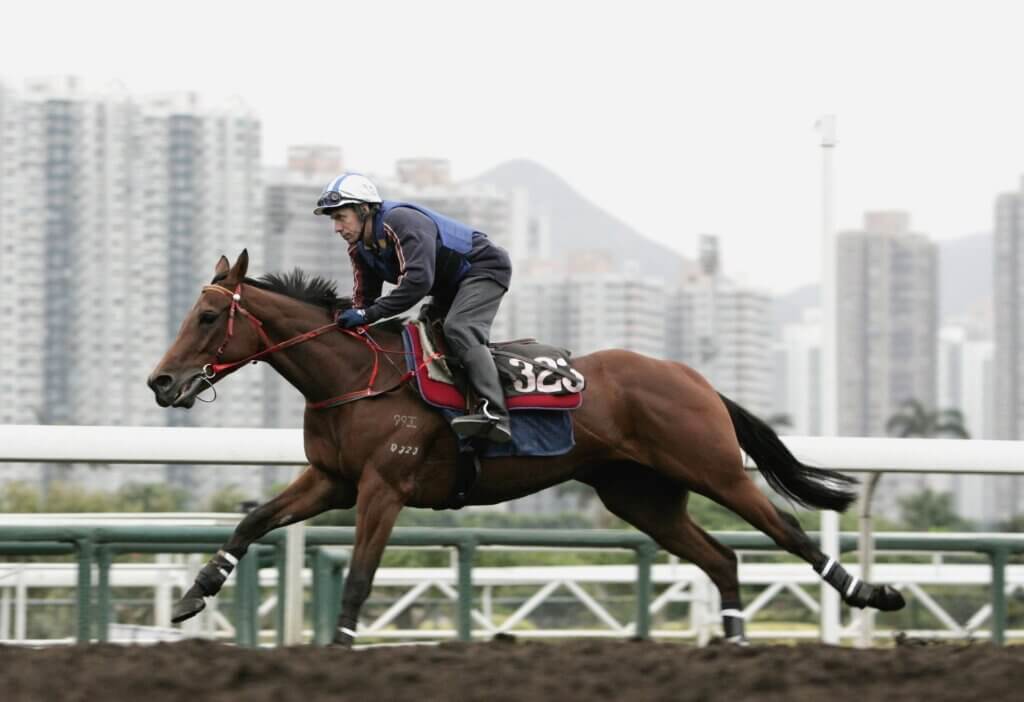
Every horse racing in Hong Kong must complete a barrier trial before taking part in a race, making trials one of the most useful clues available to punters at the start of a new season. Yet they can also be badly misleading, particularly when the horse belongs to trainer John Size.
That became clear when Ka Ying Rising’s trials were released before the new season began. With international attention focused on the Hong Kong star, racing fans overseas began studying the trial footage and times. Many, however, were unfamiliar with what a barrier trial actually tells you.
For followers accustomed to racing in countries such as Britain, Ireland, France, Japan and the United States, the concept can be particularly difficult to understand because those major racing jurisdictions generally do not use barrier trials in the same way Hong Kong does.
A barrier trial is not a race. There is no prize money, no requirement for a horse to finish first and, in many cases, no reason for a jockey to ask a horse for its maximum effort.
That distinction is the starting point for understanding trials.
What Is A Barrier Trial?
There are three main reasons a horse takes part in a trial.
The first is fitness. A trainer can use a trial to bring a horse back into racing condition after a spell without placing the same demands on it that a competitive race would.
The second is education. Young or inexperienced horses can learn how to jump from the barriers, settle among other runners, respond to a jockey and handle the conditions of a race day.
The third is remedial work. Stewards can require a horse to trial if it has developed a problem such as missing the start or displaying behaviour that creates a racing concern.
The key point is that every horse can have a different objective.
A trainer might want one horse to build fitness. Another may simply need experience. A third may be asked to improve its behaviour at the barriers.
That is why judging every trial as though it were a race can lead punters badly astray.
Trials are normally conducted at a lower intensity than races. A trainer can build fitness without exhausting the horse, while a jockey can allow the horse to travel comfortably rather than demanding everything it has.
Different trainers use that freedom in very different ways.
Danny Shum likes to bring his horses along and will often ask them for a reasonable effort in trials. Tony Cruz takes a similar approach. Brett Crawford, who comes from South Africa, has a different background because barrier trials are much less common there. He does not trial his horses as frequently and, on occasions, does not trial them at all.
It works for him.
Jamie Richards provides another interesting example this season. Most of his horses have completed two trials before going to the races, while some trainers are satisfied with one.
Then there is John Size.

The John Size Method
Size has won 13 championships during 25 seasons in Hong Kong. His approach to barrier trials is unlike almost anybody else.
A Size horse can have six, eight or even nine trials before appearing in a race. It is unusual to see one of his debutants with fewer than three.
That can leave punters scratching their heads.
Why would a trainer keep sending the same horse to trials when it appears to be doing very little?
The answer lies in Size's approach to preparation.
He does not rely heavily on hard gallops to build fitness. Instead, he gradually brings his horses along through repeated trials, allowing them to become comfortable with the surroundings and develop confidence.
For Size, the mental side of a horse matters enormously.
The purpose of a trial is not necessarily to show the public how good the horse is. The priority is to give the horse a positive experience.
That approach can produce an obvious difference on race day.
Walk through a parade ring or stand behind the barriers before a race and it is easy to see horses sweating, becoming agitated or wasting energy. Some are already working themselves into a state before the race has even begun.
Size's horses are rarely among them.
They have repeatedly experienced the process during trials. They have practised entering the barriers, standing quietly and racing in company. By the time they reach the real race, the environment is familiar.
They can save their energy for when it matters.
That is also what makes their trials so difficult for punters to interpret.
Why Size Horses Can Look Ordinary
A horse that is barely asked for an effort does not necessarily produce a trial that looks impressive.
That has caught plenty of punters out.
An experienced rider can sometimes recognise how a horse is travelling even when it is several lengths behind the main group. But that skill comes from years of watching horses and, in some cases, from having ridden them.
The writer of the original piece notes that he was riding in trials when Size first arrived in Hong Kong. His methods were so different that people could not easily assess his horses through trial performances alone.
The results were striking.
Size horses would turn up on race day and win first up at big odds despite appearing ordinary, or even poor, in their previous trials.
More than two decades later, the problem remains.
Spicy Standard won first up on the opening day after producing what appeared to be a dreadful trial. Prime Ace finished third at odds of 19 to 1 on Sunday after four trials that offered very little encouragement to the casual observer.
That does not mean trials should be ignored.
It means they must be read properly.
Wet Dirt Can Be Deceptive
One of the biggest traps in Hong Kong trials is the track surface.
When the all weather track is wet, some horses simply do not handle it. Fields can become stretched out and horses can lose momentum as dirt is thrown back into their faces.
A horse can also ease up much more sharply on wet dirt than it would on a dry surface.
That was the case with both Spicy Standard and Prime Ace.
Spicy Standard stopped badly during the final 150 metres of his dirt trial 11 days before the season opener. He finished more than 11 lengths behind the winner, while the official comment stated that he was up with the pace before weakening in the straight.
He then won first up.
Prime Ace produced an even more striking sequence.
Across four trials before his Sunday race, he was beaten by 11 lengths, then 19 lengths, then 6.5 lengths. In his final trial, held just over two weeks before the race, he finished last and was beaten 36 lengths.
He then ran third at 19 to 1.
The common factor was the track.
Both horses had completed those final trials on a surface rated wet slow.
The lesson is simple. A horse dropping rapidly away from its rivals on wet dirt does not automatically mean it is out of form.
A barrier trial is not a race.
Weight Can Change The Picture
Another factor is easy to overlook because trial results are usually presented in a way that encourages direct comparison.
There are no allocated race weights in a trial.
That means the weight carried by the jockey can have a significant effect.
Hong Kong's current apprentices, including Britney Wong and Nichola Yuen, are very light. Compare them with a heavyweight rider such as Hugh Bowman, who could weigh around 130 pounds in a trial.
The difference can approach 20 pounds.
That is a significant amount.
Come race day, horses carry their allocated weights and that needs to be factored into any assessment. A horse that looks better than another in a trial may have enjoyed a substantial advantage simply because of the rider sitting on its back.
Watch Which Horse The Jockey Chooses
Jockey bookings can provide another valuable clue.
Suppose a race is scheduled for two weeks later and one jockey rides three different horses in trials before the race.
Watch which horse the jockey ultimately chooses.
In many cases, that selection tells you something about how the rider assessed the horses during preparation.
A jockey may use a trial simply to get a feel for a horse before deciding which one to ride when the real race arrives.
That makes jockey movements especially interesting early in the season.
Zac Purton is an obvious example because he often has more choices than other riders. If he trials several horses for the same upcoming race, the horse he selects can offer an important piece of information.
It should not be treated as conclusive evidence, but it belongs in the overall picture.

Time Matters, But So Does The Effort
Punters often look at the trial clock first.
That is understandable, but it can be misleading.
A fast trial time produced by a horse being vigorously ridden is not necessarily more impressive than a slightly slower time produced by a horse travelling comfortably.
The important question is not simply how fast the horse went.
Ask how it went.
Was the jockey pushing? Did the horse respond immediately? Was it travelling comfortably before being asked to improve? Did it finish under restraint?
Those details can tell you far more than the final time alone.
New Zealand Trials Are Different
Hong Kong punters also need to be careful when assessing trials from New Zealand, particularly when looking at horses purchased from that market.
New Zealand produces many horses that eventually race in Hong Kong and Australia. But the purpose of a New Zealand trial can be different.
A significant number of horses are being presented to potential buyers.
That changes the incentive.
A horse may be tested more seriously because connections want prospective buyers to see what it can do. A good trial can increase interest and potentially influence the price.
In that sense, a New Zealand trial can function partly as a sales presentation.
A Hong Kong barrier trial generally serves a different purpose.
That difference matters when a horse arrives in Hong Kong with an impressive trial record from New Zealand.

The Size Influence Reached Australia
Size's influence has not been confined to Hong Kong.
One of the clearest examples can be seen in Australian trainer Chris Waller.
Waller recorded his first Australian winner at Wyong in 1998 and established himself at Rosehill with four horses not long before Size left Sydney for Hong Kong.
Waller has acknowledged Size's influence, and the similarities are easy to spot when watching his trials.
The basic idea is to bring horses along gradually, avoid unnecessary pressure and make their preparation a positive experience.
The racecourse is where the horse eventually has to answer the difficult questions.
That method can be seen in the consistency of Waller's horses. They are often well prepared, mentally settled and capable of sustaining high performance over long periods.
The principle is not complicated.
Fitness matters, but so does confidence.
A horse that knows what is expected of it can conserve energy instead of wasting it before the race begins.
That is what Size developed in Hong Kong, and it explains why his trials can look almost useless to an outsider.
They are not necessarily designed to reveal the horse's ability.
They are designed to prepare the horse.
Sheza Alibi Raises A Bigger Question
The discussion about preparation leads to another issue in Australian racing.
Sheza Alibi produced a superb performance in the Makybe Diva Stakes and has developed a remarkable record when racing second up.
She has raced four times second up and won all four.
Her first up record is very different. She has had four starts and won once.
Autumn Glow defeated her fairly when the pair met first up in the Winx Stakes, but Autumn Glow is herself an outstanding mare. If they meet again next start, there may be much less between them.
That raises a broader question.
Why do so many of Australia's outstanding horses of this century appear to be mares?
Black Caviar, Makybe Diva and Winx immediately come to mind.
The current generation includes Autumn Glow and Sheza Alibi.
Both are mares.
There may be several reasons. Top colts are often sent to stud early, cutting short their racing careers just as they reach the highest level. In previous decades, leading Australian geldings were also frequently sold overseas, including to Hong Kong.
That market has changed. High quality Australian geldings now command prices that Hong Kong buyers are often unwilling to meet.
The use of anabolic steroids also changed in the 1990s, creating another possible factor in the performance gap between male and female horses.
But there is another question worth asking.
Should the weight for age scale be reconsidered for major races?
Sheza Alibi received a two kilogram allowance against the older male horses on Saturday because she is a mare. She was so dominant that she appeared capable of carrying additional weight and still winning.
If mares are increasingly producing the strongest performances at the highest level, should the traditional allowances remain unchanged?
That is a question worth putting to trainers, riders and racing authorities.
And for anyone studying Hong Kong barrier trials this season, there is an easier question to start with: are you judging what the horse actually showed, or simply judging the result on the page?