


With the Iran war weighing on his approval ratings and economic concerns dominating voters’ attention, President Donald Trump is increasingly using provocative announcements and political spectacle to shape the national conversation ahead of November’s midterm elections.
US President Donald Trump has never been reluctant to seize the spotlight, but a series of unusual announcements and political provocations in recent weeks has raised questions about whether the president is deliberately trying to divert public attention from issues that could hurt Republicans in November’s midterm elections.
From threatening to rename Lake Ontario as “Lake America” to unexpectedly reviving the possibility of talks with North Korean leader Kim Jong Un, Trump has repeatedly shifted the political conversation away from the war with Iran and the US economy.
The moves have come as Trump faces a difficult political environment. His approval rating has remained in the low 30s in polls, while the conflict with Iran has entered its sixth month with no clear resolution. At the same time, persistent concerns over oil prices and the cost of living could make economic conditions a central issue when voters go to the polls.
William Galston of the Brookings Institution said Trump was well known for using diversions to change the subject when political developments were moving against him.
“This president specializes in diversions,” Galston told AFP.
The strategy is familiar to anyone who has followed Trump’s political career. The former reality television star has frequently relied on dramatic announcements, personal attacks and provocative claims to dominate news coverage and draw attention away from subjects that are less politically favourable.
But the stakes are particularly high this year as Republicans prepare for a midterm contest that could determine control of Congress.
Iran war creates political problem
The conflict with Iran represents one of the most difficult challenges for Trump.
The president returned to office promising a more restrained approach to foreign military involvement and repeatedly criticised previous administrations for drawing the United States into prolonged conflicts overseas.
Yet the war with Iran has now continued for months, creating a political problem for a president who built much of his appeal around the promise of putting American interests first.
The conflict has also affected the economic outlook. Oil prices have remained a major concern, with higher energy costs threatening to feed into household expenses and increase pressure on inflation.
For voters, such issues can be difficult for a president to escape because they are felt directly in everyday life.
The Atlantic reported that the White House had been seeking ways to push the Iran conflict further into the background by avoiding additional military action and placing greater emphasis on economic measures targeting Tehran.
The approach reflects a basic political calculation. If the administration can reduce the amount of attention given to the war, Trump may have greater room to promote domestic policies and portray his presidency as delivering results.
The difficulty is that international conflict can quickly affect domestic conditions, particularly when energy prices rise.
“It’s hard to change people’s minds when you’re talking about things they’re experiencing directly,” Galston said.
Lake America announcement sparks criticism
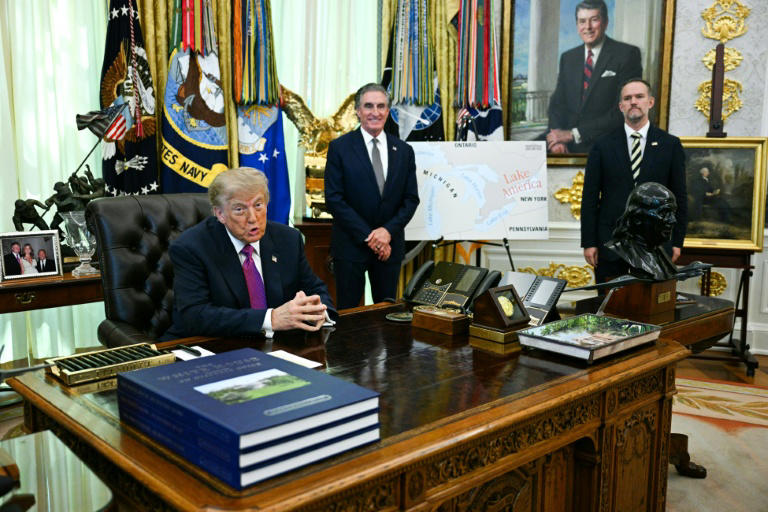
One of the clearest examples of Trump’s headline driven approach came when he summoned reporters to the Oval Office and announced an order to rename Lake Ontario as “Lake America.”
The proposal immediately attracted attention, particularly because it followed days of heightened tensions between Washington and Ottawa over trade.
Trump has repeatedly used disputes with Canada to reinforce his “America First” political message. The lake announcement provided another opportunity to turn a complicated economic and diplomatic dispute into a highly visible symbol of his nationalist agenda.
Democrats quickly criticised the move.
Senate Minority Leader Chuck Schumer described it as a “juvenile” distraction, arguing that the administration should be addressing economic pressures facing American households rather than focusing on symbolic gestures.
“It’s a pathetic attempt at distraction, and it’s working families who are paying the price,” Schumer said in a statement following the announcement.
The controversy nevertheless achieved one of the main objectives of any modern political spectacle: it generated extensive media coverage and pushed other issues further down the news agenda.
Kim Jong Un returns to Trump’s agenda
Trump also surprised observers by reviving the prospect of renewed engagement with North Korean leader Kim Jong Un.
The president had rarely spoken publicly about Kim since returning to the White House in January 2025, despite having met the North Korean leader three times during his first term.
Trump recently returned to the subject, praising Kim while criticising South Korea and announcing changes involving joint military exercises between Washington and Seoul.
The renewed focus on North Korea provided another foreign policy story at a time when the administration was facing intense scrutiny over Iran.
Trump has long viewed his personal relationship with Kim as evidence that his unconventional diplomacy can achieve results where traditional negotiations have failed.
During his first presidency, the two leaders held unprecedented meetings and exchanged public praise as well as threats. Although their diplomacy did not produce a lasting agreement on North Korea’s nuclear programme, Trump has continued to present the relationship as one of his foreign policy achievements.
The sudden return of Kim to the political conversation therefore served two purposes. It allowed Trump to revisit a familiar theme from his first presidency while also generating a fresh foreign policy narrative.
White House makeover becomes part of political messaging
Trump has also been increasingly vocal about changes to the White House, another subject that has generated significant media attention.
On his Truth Social network, he recently discussed work being carried out at the presidential residence, including the cleaning and regrouting of granite at the entrance.
Supporters may view the changes as evidence of Trump’s determination to reshape the White House according to his preferences.
Democrats, however, have sought to portray the focus on renovations and aesthetics as evidence that the president is disconnected from ordinary Americans dealing with higher costs.
The competing interpretations demonstrate how almost any action by Trump can become part of the wider political battle.
Trump puts himself at centre of midterm campaign
While the president appears eager to redirect attention away from difficult subjects, he is simultaneously encouraging voters to focus heavily on him.
Trump has taken an increasingly direct role in Republican primary contests ahead of the midterms, supporting candidates he believes will advance his political agenda.
After several candidates backed by Trump performed strongly in primary elections, the president appeared confident that his personal popularity among Republican voters could help the party retain control of Congress.
“Pretend I’m on the ballot,” Trump told Fox News.
The comment captures the central role Trump continues to play within the Republican Party.
Unlike presidents who traditionally remain somewhat removed from congressional elections, Trump has embraced the midterms as a referendum on his presidency. His political operation is reportedly preparing to spend heavily on television advertising highlighting his record.
Trump’s political network has access to a war chest of about $400 million, giving him substantial resources to influence races across the country.
The White House has also sought to present the administration as having achieved a series of victories. This week, officials highlighted what they described as 14 recent wins on issues including restrictions on mail in voting and increased deportations of migrants.
The messaging is designed to remind Republican voters that Trump has delivered on promises made during his campaign.
Republicans face uncertain midterm landscape
Despite the president’s efforts to control the political narrative, the midterms remain a significant challenge for Republicans.
Historically, the party occupying the White House often faces losses in congressional elections held midway through a presidential term. Voters frequently use midterms to express dissatisfaction with the administration, particularly when economic conditions are difficult.
Trump therefore has a strong incentive to ensure the elections become a contest over issues on which he believes Republicans have an advantage.
Immigration remains one such issue. Trump has made deportations and border enforcement central to his political identity, and the administration has repeatedly highlighted its immigration policies as evidence that it is fulfilling campaign promises.
But the economy could prove harder to manage politically.
If oil prices remain elevated and household expenses continue to rise, voters may focus less on symbolic political battles and more on their personal financial circumstances.
That could make Trump’s attempts to dominate the news cycle less effective.
A president who thrives on attention
Trump’s political strength has always been closely connected to his ability to command attention.
As a businessman and television personality before entering politics, he developed a highly confrontational public style that allowed him to remain at the centre of the news cycle.
His presidency has followed the same pattern.
Provocative statements, unexpected announcements and attacks on political opponents regularly generate headlines, sometimes overshadowing more detailed policy debates.
That approach can be highly effective when Trump is seeking to rally his supporters or put opponents on the defensive.
The question is whether it can work when voters are primarily concerned about issues such as energy prices, inflation and the consequences of a prolonged war.
The White House may also face the loss of one of its most effective communicators following the departure of Press Secretary Karoline Leavitt, who said she wanted to devote more time to her children.
Without one of the administration’s strongest public messengers, Trump may increasingly have to carry the burden of setting the political agenda himself.
Trump’s influence beyond the midterms
The midterm elections may also determine the next phase of Trump’s influence over the Republican Party.
A strong Republican performance would strengthen his position and reinforce his claim that his political movement remains capable of delivering electoral victories.
A poor result could encourage Republican politicians to begin looking beyond Trump and towards the party’s next generation of leaders.
Trump, however, has already shown signs that he intends to remain at the centre of Republican politics well beyond the midterms.
He has repeatedly hinted at the possibility of seeking a third presidential term, despite the US Constitution limiting presidents to two elected terms.
Even if such a campaign is ultimately impossible, continued speculation about Trump’s political future would allow him to remain a central figure in American politics.
He could also wield considerable influence over the 2028 Republican presidential field by deciding which candidates receive his endorsement.
For now, the immediate challenge is November.
Trump is trying to persuade voters to judge his presidency on his own terms, while Democrats are seeking to keep attention focused on the issues they believe are most damaging to him.
The president’s ability to create controversy and dominate headlines remains formidable. But as the midterms approach, the decisive question may be whether political spectacle can overcome the issues Americans experience every day.
If the Iran war continues, oil prices remain high and household costs stay elevated, changing the subject may become increasingly difficult, no matter how dramatic the next announcement from the White House may be.