

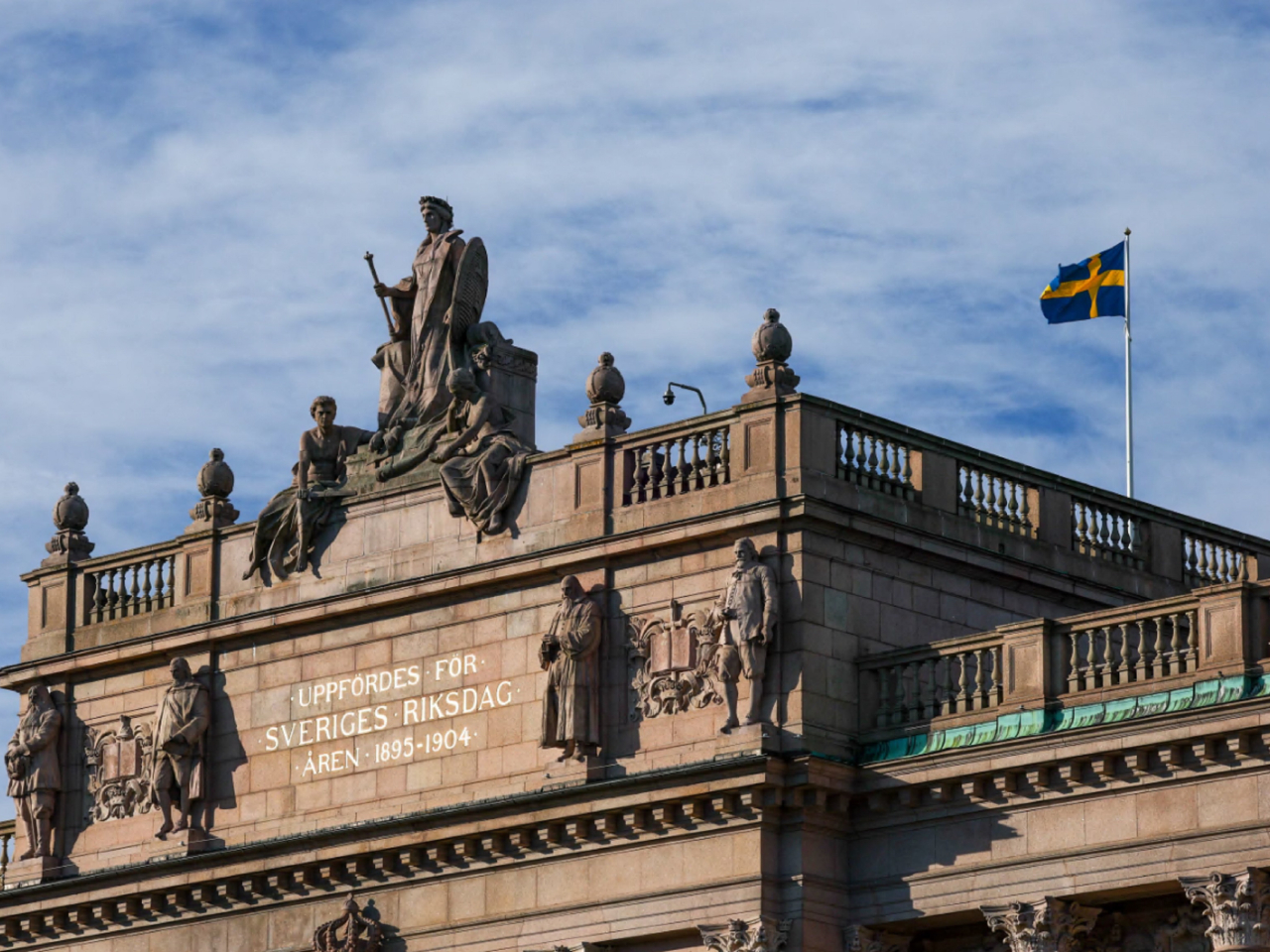
Andreas Norlén has been re elected speaker of Sweden’s Riksdag after the newly elected parliament gathered in Stockholm on Monday, giving the Moderate Party politician another term as lawmakers begin work following the September 13 election. Norlén won 200 votes in a secret ballot, defeating Social Democratic candidate Johanna Haraldsson, who received 146 votes, while one ballot was declared invalid.
The vote took place as Sweden entered a new parliamentary term with no government yet formed. The election produced a narrow majority for the centre left opposition, leaving Social Democratic leader Magdalena Andersson facing the difficult task of finding enough support to form a government.
Norlén’s re election adds another layer to those negotiations because the speaker plays a formal role in the process of selecting a prime minister. Under Sweden’s parliamentary system, the speaker consults with party leaders and proposes a candidate for prime minister, who must then secure sufficient support in the Riksdag.
The new Riksdag has 349 seats. The Social Democratic Party emerged from the election as the largest individual party with 99 seats, followed by the Moderate Party with 70 and the Sweden Democrats with 62. The Left Party won 30 seats, the Centre Party 25, the Christian Democrats 22, the Green Party 22 and the Liberal Party 19.
Norlén defeats Social Democratic candidate
Norlén, who has served as speaker since 2018, was nominated by the Moderate Party for another term. His candidacy received backing from the other parties in the outgoing governing bloc as well as the Left Party, which had previously supported Andersson in efforts to build a new government.
The final ballot showed a clear majority for Norlén. He secured 200 votes compared with Haraldsson’s 146. The result allows him to continue directing the parliamentary proceedings during the 2026 to 2030 electoral period.
Haraldsson was the Social Democrats’ candidate for the position. The party had sought a change in the speaker’s office following the election, but the numbers in Monday’s vote prevented that from happening.
Norlén’s position also carries significance beyond the running of parliamentary sessions. The speaker is responsible for managing the Riksdag’s work and has a formal role in the process of government formation. Following an election in which no party won a majority on its own, those responsibilities become particularly important.
The Riksdag is scheduled to formally open its 2026 to 2027 session on Tuesday, September 29. Monday’s proceedings included the roll call of members and the election of the speaker and deputy speakers.
Andersson ends first attempt to form government
The speaker election came after Magdalena Andersson ended her initial attempt to form a new government.
Andersson had received the assignment to explore government formation after Prime Minister Ulf Kristersson resigned following the election result. The resignation came after the centre left opposition secured 176 seats, compared with 173 seats for the parties supporting the outgoing centre right government.
Although the Social Democrats won the largest number of seats, the four parties on the centre left did not automatically translate their parliamentary majority into an agreed governing coalition.
Andersson had held discussions with other parties after the election, but the decision by the Left Party to support Norlén for speaker changed the political calculations surrounding the government talks.
According to Swedish public broadcaster SVT, Andersson argued that the Left Party’s support for the Moderate candidate indicated the emergence of a new parliamentary grouping. She subsequently gave up the government formation assignment she had received on September 18.
The Left Party disputed that interpretation. Its deputy leader Ida Gabrielsson said the party remained clear in its support for Andersson as prime minister, according to SVT.
The disagreement illustrates the difficulty facing the centre left parties. Holding a combined parliamentary majority does not by itself establish a government. The parties still need to agree on cooperation arrangements and secure enough parliamentary support for a prime minister.
Election leaves Sweden with a narrow parliamentary majority
Sweden held its parliamentary election on September 13. The Swedish Election Authority formally confirmed the final results on September 19 after completing the vote count.
A total of 6,834,413 people voted in the Riksdag election, producing a turnout of 84.9 percent. The Social Democrats received 28.02 percent of the vote and won 99 seats. The Moderate Party received 19.85 percent and won 70 seats.
The final parliamentary distribution gives the Social Democrats, Left Party, Green Party and Centre Party a combined 176 seats. The Moderate Party, Sweden Democrats, Christian Democrats and Liberals hold 173 seats.
That three seat difference gives the centre left side a parliamentary majority, but it does not remove the need for negotiations.
The Centre Party has maintained reservations about cooperating with a government that includes the Left Party, while the Left Party has its own political priorities. Those differences make the formation of a unified governing arrangement more complicated than the seat totals alone suggest.
The Sweden Democrats also remain a significant force in the new Riksdag with 62 seats, despite receiving a smaller share of the vote than in the previous election. The party is now the third largest group in parliament, behind the Social Democrats and Moderates.
Kristersson resigns after election defeat
Ulf Kristersson, leader of the Moderate Party, announced his resignation as prime minister on September 17 after the final election count confirmed that the governing bloc had fallen short of a parliamentary majority.
Kristersson had served as prime minister before the election and led a centre right government supported by the Sweden Democrats. Following the result, he submitted his resignation while the process of forming a new government began.
The resignation did not immediately hand government formation to Andersson. Instead, the speaker’s consultations and the positions taken by the different parties became central to determining the next step.
Norlén announced on September 18 that he had received the authority to begin the process of finding a candidate capable of forming a government. His re election on Monday means he will continue in the parliamentary role while the government formation process moves forward.
New speaker faces immediate political test
The Riksdag’s new electoral period begins with several unresolved questions.
The first is who can gather enough parliamentary support to become prime minister. The second concerns the shape of any governing arrangement between the parties that collectively hold 176 seats. The third is whether those parties can maintain cooperation once a government is established.
Norlén now has the formal responsibility of consulting party leaders and proposing candidates for prime minister. A candidate does not need to win a majority of all 349 lawmakers, but a majority of the Riksdag cannot vote against the proposed candidate.
The speaker election itself demonstrated how quickly parliamentary alliances can become complicated. The Social Democrats remain the largest party, yet their candidate lost the speaker vote after the Left Party backed Norlén.
The immediate focus will therefore shift from the speaker election to the government formation process. With the Riksdag divided between two closely matched blocs and several parties holding positions that do not fully align, negotiations will determine whether the 176 seat opposition majority can translate into a workable government.
For Sweden’s newly elected parliament, the next decisive step is clear: party leaders must turn their election mandates into an agreement capable of winning parliamentary support for the country’s next government. What kind of governing arrangement will emerge from the 176 seat opposition majority?