

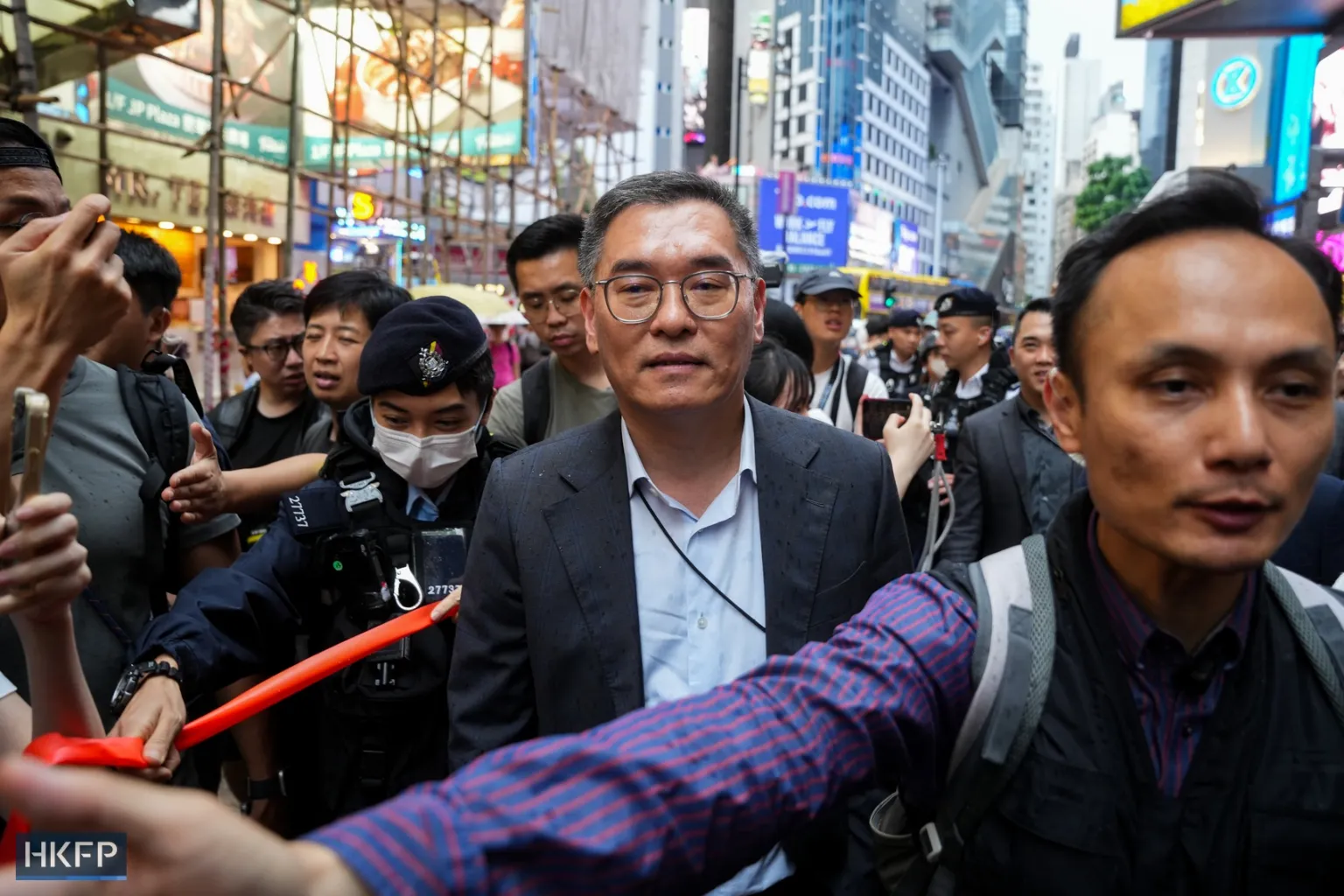
Hong Kong's outgoing national security chief has defended police raids on independent bookstores and described calls for a clear list of prohibited books as a form of “soft resistance,” intensifying a debate over how far the city's national security laws extend into the publishing and bookselling industry.
Andrew Kan Kai yan, who recently stepped down as deputy police commissioner responsible for national security after 35 years with the force, said police had not abused their powers when they searched independent bookstores and arrested five people on suspicion of sedition in July.
Kan said the law already provides sufficient guidance on conduct that can amount to a national security offence. He argued that booksellers should examine the material they intend to sell or obtain legal advice if they are uncertain about its contents.
His remarks come as independent booksellers face increasing uncertainty over which politically sensitive publications may expose them to criminal investigation. The government has repeatedly rejected calls for an official list of banned books, while officials have warned that booksellers themselves must ensure the titles they offer do not breach national security legislation.
Kan calls questions over banned books “soft resistance”
In an interview before leaving his post, Kan was asked why authorities had not published a list identifying books that could not legally be sold in Hong Kong.
“Saying there is no list of banned books or that the red lines are unclear, I think that is a form of soft resistance,” Kan said.
The term has become increasingly common in Hong Kong's national security discourse, although officials have not provided a single, publicly defined explanation of what conduct falls within the category.
“Soft resistance” first entered official discussion in Hong Kong in 2021, when Luo Huining, then director of the central government's liaison office in the city, used the term in a speech. Since then, senior officials have repeatedly warned about it as a national security concern.
Security Secretary Chris Tang Ping keung recently described soft resistance as the “most malicious” threat facing national security in Hong Kong.
Kan's comments therefore place ordinary questions about the boundaries of book sales within a much wider official debate over activities that authorities consider capable of undermining national security.

Bookstores caught in the uncertainty
The dispute became more visible in July when national security police searched two independent bookstores and arrested five people on suspicion of sedition.
The targeted businesses included Have a Nice Stay in Prince Edward and Greenfield Book Store in Mong Kok. Police seized publications that they said contained seditious material. The five people arrested were later released on bail pending further investigation.
The raids followed earlier arrests involving independent bookstore operators.
Have a Nice Stay had also announced that it would close, citing financial difficulties and uncertainty over what material could legally be sold. The store's owners had raised concerns about unclear legal boundaries surrounding books that might attract the attention of national security authorities.
The issue has affected more than individual retailers. Independent booksellers have increasingly faced decisions over whether to stock politically sensitive titles, particularly publications concerning events or figures connected to Hong Kong's recent political history.
A separate report in July found that Hong Kong customs had increased inspections of book shipments from Taiwan. The territory's Customs and Excise Department said it was committed to safeguarding national security and would seize items considered seditious and refer cases to police.
“We actually read the books”
Kan said the police approach does not depend on maintaining a published catalogue of prohibited titles.
“We've taken it one step further than bookstore owners and their staff, we actually read the books,” he said.
His message to booksellers was straightforward. Before putting a title on sale, they should read it and assess its contents or seek legal advice. If they remain uncertain, he suggested that they should simply decide not to sell it.
Kan also explained why he believed a permanent banned book list would be impractical.
“If we release a list of banned books now, and a new illegal title is released the next day, people will question why arrests were made if it wasn't on the list,” he said.
The government's position is similar. Tang said in July that authorities would not produce a list of banned books, arguing that offenders could use such a list to evade the law by changing titles or publishing new versions.
For booksellers, however, the absence of a list leaves a different problem. They must make decisions about potentially sensitive publications without knowing in advance whether authorities will later regard those books as unlawful.
That uncertainty has already contributed to caution among some independent retailers.

Police say legal checks come before enforcement
Kan said national security police do not simply decide on their own that a book has crossed the legal boundary.
Before taking enforcement action, he said officers consult the Department of Justice to determine whether the content could violate national security legislation.
That process means a police investigation can begin without a book appearing on any pre existing list of prohibited titles.
The approach also places considerable importance on the interpretation of individual publications and their alleged intent.
Hong Kong's national security framework has expanded significantly since the city introduced its national security law in 2020. The Safeguarding National Security Ordinance, enacted later, added further offences and enforcement powers.
The authorities maintain that the legislation provides the legal basis for action against conduct that threatens national security. Critics, however, have raised concerns about uncertainty surrounding the application of the laws to speech, publications and political expression.
A conservative Christian organisation, the Society for Truth and Light, criticised the government's refusal to publish a banned book list after the July raids. The organisation said the approach amounted to an abuse of power and weakened confidence in the rule of law.
It was reported as the only civil society organisation in Hong Kong to publicly oppose the raids.
Booksellers face a difficult calculation
The dispute illustrates a practical problem for Hong Kong's independent book trade.
A bookseller who removes a potentially sensitive title avoids one possible source of legal exposure but also risks narrowing the range of material available to customers. A bookseller who continues selling the publication may believe it falls within the law, only to discover later that authorities take a different view.
The uncertainty is particularly significant for smaller independent stores, which may not have the financial resources to obtain legal advice on every title.
The government has placed responsibility on booksellers to assess what they sell. Kan's remarks reinforce that position.
But the question of where the legal boundary sits remains central to the dispute.
The issue is not simply whether authorities have the power to investigate or seize books. It is whether retailers can reasonably determine beforehand which publications may result in criminal scrutiny.
That distinction has become increasingly important as national security enforcement has extended into areas beyond traditional espionage or violent threats.
Books about politically sensitive subjects have already become harder to find in some Hong Kong independent bookstores. A 2025 review found that titles about the 1989 Tiananmen crackdown had become increasingly scarce, with booksellers citing legal uncertainty and concerns about crossing national security “red lines.”
A new national security chief takes over
Kan's comments come as Hong Kong's police national security department enters a new chapter.
Kelvin Kong Hok lai has succeeded Kan as deputy police commissioner responsible for national security. Kong previously served as director of national security and has spent three decades in the police force. His appointment took effect after he took the required oath of office.
Kan's departure follows 35 years of service with the Hong Kong Police Force. His final period in office came amid an expanding national security agenda that now includes concerns over artificial intelligence, online activity and what officials describe as soft resistance.
The transition does not signal a change in the government's stated position on books.
For now, there is still no official catalogue telling Hong Kong booksellers which titles are prohibited. Instead, retailers are expected to assess publications themselves, seek legal advice where necessary and avoid material they believe could violate national security laws.
That leaves a simple question at the centre of the debate: Should Hong Kong publish clearer rules for booksellers so they can understand the legal limits before a book reaches the shelves?