

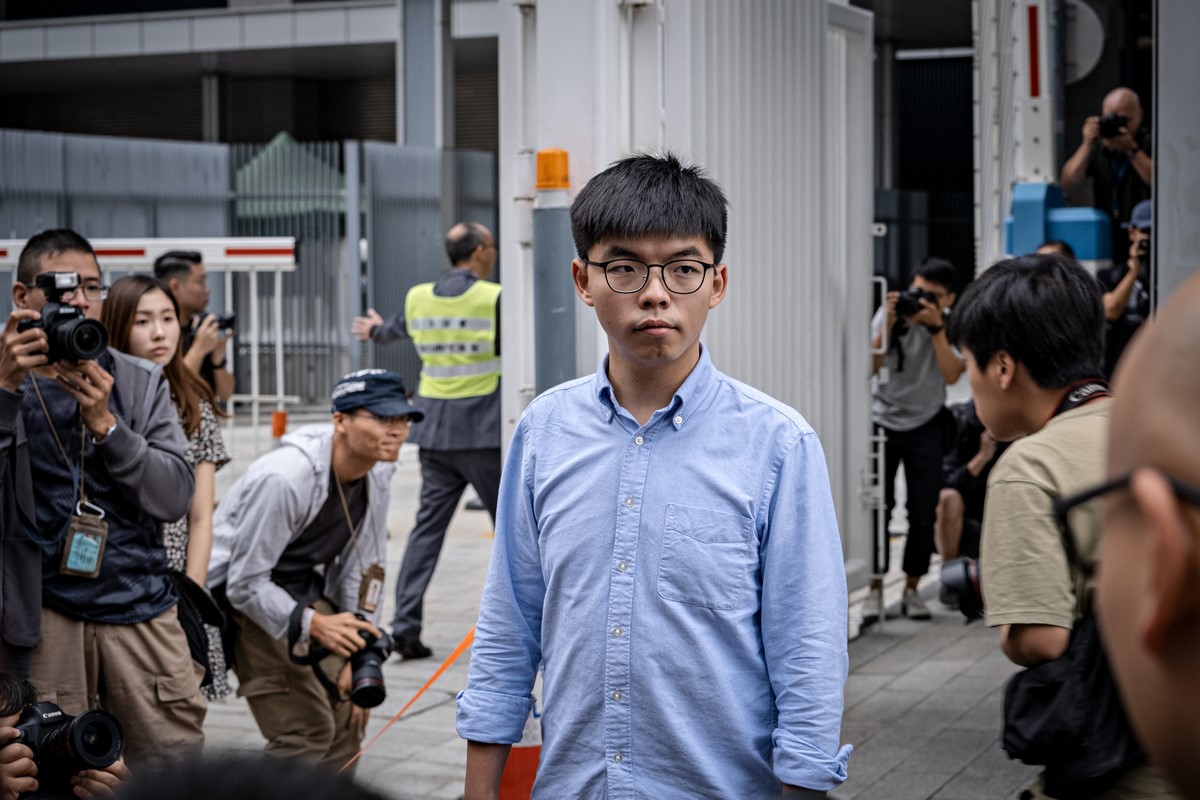
Joshua Wong pleaded guilty on Wednesday to conspiring to collude with foreign forces, adding a second national security conviction to the prison sentence he is already serving in Hong Kong.
The 29 year old activist appeared before the High Court and answered “guilty” in a clear voice when the charge was put to him. The full charge was read aloud by a court clerk because of what the court described as the high level of public interest surrounding the case.
Prosecutors accuse Wong of conspiring in 2020 with fellow activist Nathan Law and others to persuade foreign governments to impose sanctions, blockades or other hostile measures against Hong Kong and mainland China.
The offence carries a maximum sentence of life imprisonment. Wong’s guilty plea means the court will now determine how long he must remain behind bars.
Case centres on overseas lobbying
The prosecution’s case focuses on Wong’s activities in the international arena following the mass pro democracy protests and unrest that shook Hong Kong in 2019.
Wong and Law were prominent members of Demosisto, a political party they founded in 2016. The party advocated democratic self determination for Hong Kong and became one of the better known political groups associated with the city’s younger pro democracy movement.
According to a summary of facts presented to the court, the pair sought to build what prosecutors described as an “international battlefront” after the 2019 protests.
Wong remained in Hong Kong while continuing to campaign internationally, prosecutors said. His activities included communicating with foreign media and using social media platforms to promote calls for sanctions against Hong Kong or the central government in Beijing.
Prosecutors also referred to Wong’s efforts to encourage the United States to introduce legislation addressing human rights and democracy in Hong Kong in 2019. He also appealed to other Western governments to establish sanctions programmes similar to the Magnitsky sanctions used against individuals accused of serious human rights abuses and other offences.
The prosecution said Wong continued his international lobbying after Beijing imposed the national security law on Hong Kong in June 2020.
Law left Hong Kong and continued the campaign from overseas, according to the prosecution. He now lives in the United Kingdom and is wanted by Hong Kong national security police.

Second national security conviction
Wong is already serving a sentence of four years and eight months for conspiracy to subvert state power in the landmark national security prosecution involving 47 opposition politicians and activists.
He was among 45 defendants convicted and sentenced in 2024 after the court found them guilty in the case commonly known as the Hong Kong 47.
That sentence had been expected to keep Wong in prison until January 2027. His lawyer, Senior Counsel Derek Chan, told the High Court that the new foreign collusion case has changed that calculation.
Chan also told the court that the Correctional Services Department had informed Wong that he would not receive remission on his existing sentence. Such a reduction can normally shorten a prison term for good behaviour, subject to the applicable rules and decisions of the correctional authorities.
The loss of a possible remission could affect the date on which Wong completes his existing sentence, while the new conviction could result in additional years in prison.
Wong entered the courtroom wearing a navy shirt and thick black rimmed glasses. He appeared thinner than in earlier public appearances and acknowledged supporters and former colleagues sitting in the public gallery.
Among those watching were former members of Scholarism, the student activism group Wong founded in 2011 and which played a prominent role in Hong Kong’s earlier protest movements.
Lawyer seeks shorter sentence
Chan asked the court to impose a sentence that recognises Wong’s guilty plea and the circumstances surrounding the case.
Under Hong Kong’s national security law, foreign collusion offences can carry a prison term ranging from three to 10 years. Where a court considers an offence to be of a grave nature, the minimum sentence rises to 10 years.
Chan argued that Wong’s conduct did not reach that higher threshold.
The defence compared Wong’s case with that of media entrepreneur Jimmy Lai, who was sentenced to 20 years in prison in February for the same offence. Three former senior executives of Lai’s Apple Daily newspaper were also sentenced to 10 years each.
Chan asked the court to begin with a sentence of no more than 10 years before applying the usual reduction associated with Wong’s guilty plea. He also requested a further two year discretionary reduction, citing delays in the prosecution of the case.
The defence lawyer told the court that the sentence should leave Wong with “an end in sight” and give him hope for his future after prison.
Judge William Tam said he would decide the sentence as soon as possible before adjourning the hearing.
The final sentence will determine how much longer Wong remains in custody and whether his imprisonment extends substantially beyond the release date that had previously been expected.

Wong says goodbye to supporters
As correctional officers escorted Wong from the courtroom, he turned towards the public gallery and waved.
“Goodbye, goodbye,” he said.
Louis Lee, a former member of Scholarism, told reporters afterwards that Wong appeared to be in good spirits during the hearing.
Lee said Wong had been a friend to those who had known him for many years and that they would continue to support him.
Wong has spent much of his adult life in custody. He was 24 when he entered prison and will turn 30 next month.
Chan told the court that Wong had used his time in custody to read extensively. According to his lawyer, the activist had read more than 100 books by writers from different parts of the political spectrum.
His lawyer said Wong had also hoped to care for his ageing parents after his release.
Those comments offered a glimpse into the personal consequences of a legal case that has already kept Wong behind bars for years. The defence sought to persuade the court that his conduct since his imprisonment, including his reading and reflection, should be taken into account when deciding the sentence.
Security law transformed Hong Kong politics
Beijing imposed the national security law on Hong Kong in June 2020 following months of protests and political unrest in the city.
The legislation created offences covering secession, subversion, terrorism and collusion with foreign forces. It also gave authorities wider powers to investigate and prosecute conduct considered a threat to national security.
Hong Kong authorities have defended the legislation, saying it restored stability and public order after the unrest of 2019. Critics, including international organisations and human rights groups, have argued that the law has sharply restricted political freedoms and space for civil society.
Hundreds of people have been arrested under the security framework, while opposition politicians, activists, journalists and civil society organisations have faced prosecutions, arrests or dissolution.
Demosisto itself announced that it would disband on the day the national security law came into effect. The decision effectively ended the political organisation that had brought Wong and Law together at the centre of Hong Kong’s younger pro democracy movement.
Law left Hong Kong and later settled in Britain. Hong Kong national security authorities have placed him on a wanted list and offered a HK$1 million reward for information leading to his arrest.
Wong, meanwhile, remained in Hong Kong and was eventually imprisoned.
His guilty plea on Wednesday brings another major stage of his legal troubles to a close, but it also places a new question before the High Court: how many more years will he spend behind bars?
The court’s sentencing decision will determine whether Wong’s expected January 2027 release remains within reach or whether his second national security conviction pushes that date substantially further into the future.