

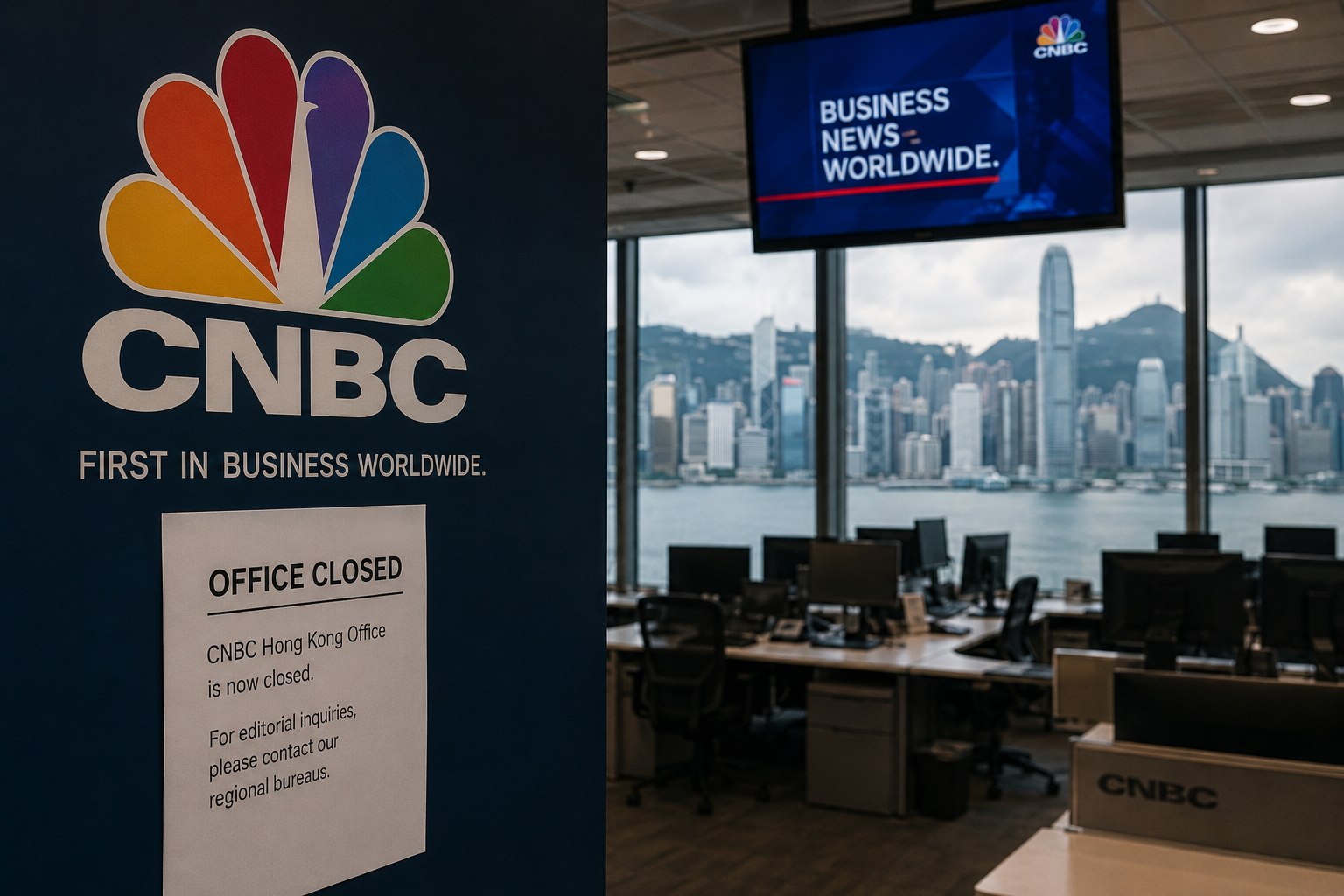
CNBC is closing its Hong Kong office and cancelling several daily live television programmes as the business network reorganises its news and production operations under Versant Media Group.
The changes will affect a number of programmes produced for international audiences, including Inside India, The China Connection and Europe Early Edition, according to an email CNBC sent to Bloomberg. Two other programmes, CNBC Meets and Built for Billions, are also expected to be scrapped as part of the restructuring.
The decision marks a significant change for CNBC's operations in Hong Kong, where the broadcaster has maintained a presence serving audiences across Asia. The office closure does not mean the network is withdrawing from coverage of Hong Kong or the wider region. CNBC said its reporting from Asia would continue, with journalists and editorial teams based in several other major international centres.
Hong Kong office to shut
CNBC said the Hong Kong office would close "as part of this programming and production restructuring." The company did not indicate that coverage of Hong Kong itself would end, instead stressing that reporting from the city and the wider region would remain part of its Asia operation.
A CNBC spokesperson said news coverage of Hong Kong and the surrounding region would continue as part of the network's broader Asia coverage.
International reporting will be led by editorial teams in London, Abu Dhabi, Singapore and Beijing, according to the company.
That structure gives CNBC the ability to continue covering markets, companies and political developments across Asia without maintaining the same level of production infrastructure in Hong Kong. It also reflects a broader shift in the way international television networks distribute reporting and live programming across regional hubs.
For viewers, however, the changes will mean fewer live programmes carrying CNBC's international output. The cancellations affect shows that have provided regular programming aimed at audiences following business and economic developments across different regions.
Several daily programmes affected
Among the programmes being cancelled are Inside India, The China Connection and Europe Early Edition.
Each programme served a different part of CNBC's international schedule. Inside India focused on developments in one of Asia's largest and fastest growing economies, while The China Connection centred on China and its role in global business and markets. Europe Early Edition provided coverage timed for audiences beginning their trading day in Europe.
CNBC also plans to discontinue CNBC Meets and Built for Billions, further reducing the network's scheduled programming.
The cuts come at a time when traditional television networks are under pressure to reconsider the cost of producing live programming. Maintaining bureaux, studios, technical operations and teams across multiple cities can be expensive, particularly when audiences increasingly consume business news through websites, mobile applications, streaming services and social media.
The restructuring therefore affects more than individual television programmes. It points to a reassessment of how CNBC organises its international newsroom and where it places its production resources.

Changes follow Comcast's Versant spin off
The restructuring comes months after Comcast separated its cable television networks into a new company called Versant at the beginning of 2026.
CNBC was among the networks moved into the new company, alongside MS NOW and other cable assets. The spin off created a standalone media group responsible for the businesses that had previously operated within Comcast's broader corporate structure.
The separation has been followed by efforts to reshape operations across the newly established company. CNBC had already carried out staff reductions earlier in 2026, with around 10 employees reportedly losing their jobs.
Among those affected was the managing editor of CNBC's website, a position closely connected to the network's digital news operation.
The latest changes suggest that the network's review is extending beyond staffing and into its international production structure and programme schedule.
Regional reporting will continue
Despite the closure of the Hong Kong office, CNBC has made clear that it does not intend to abandon its reporting responsibilities in Asia.
The company said its Hong Kong and wider regional news coverage would continue, with international reporting led from London, Abu Dhabi, Singapore and Beijing.
Those cities already serve as major centres for international journalism and financial reporting. Singapore, in particular, has become an important base for financial news organisations covering Southeast Asian markets, while Beijing remains central to reporting on China's economy, politics and business environment.
The continued presence of editorial teams across several locations also means CNBC can maintain coverage across different time zones. A network with bureaux in Asia, the Middle East and Europe can move stories through its reporting operation as markets open and close around the clock.
The change in Hong Kong therefore appears to be a shift in where CNBC produces its coverage rather than an end to its interest in the city.
Hong Kong remains important to financial news
Hong Kong has long been an important centre for international finance, connecting mainland Chinese companies and investors with global capital markets. The city is home to one of the world's major stock exchanges and remains closely linked to financial activity in mainland China.
That makes the decision to close a local CNBC office notable even as the company says its reporting will continue.
A newsroom does more than provide a physical location for journalists. Local bureaux can give international broadcasters access to executives, policymakers, analysts and market developments as they happen. Closing such an office can reduce fixed costs, but it can also change the way a network gathers and produces stories.
CNBC's stated plan is to maintain regional coverage through its other editorial centres. That approach places greater emphasis on coordination between bureaux rather than maintaining a dedicated production base in every major financial city.
A broader shift in business news
The CNBC changes also come against a wider transformation in business journalism. Financial news audiences now have access to market information almost instantly through digital platforms, while broadcasters compete with specialist websites, newsletters, social media feeds and streaming services.
Television networks have consequently had to reconsider which live programmes justify the expense of daily production.
For CNBC, the latest cancellations remove several scheduled shows while preserving its wider international reporting operation. The company can concentrate resources on fewer programmes and continue producing news through established editorial hubs.
The impact will be felt most directly by the journalists and production staff connected to the affected programmes and Hong Kong operation. For viewers, the change will appear primarily through the network's schedule and the locations from which its reporting is produced.
CNBC's decision also illustrates how the creation of Versant is beginning to affect the structure of the businesses that moved into the new company. The Hong Kong closure and programme cancellations follow the staff reductions announced earlier in the year, making the latest move part of a sequence of changes rather than an isolated programming decision.
For now, CNBC says its commitment to covering Hong Kong, China and the broader Asian region remains in place. The difference will be where that coverage is produced and which live programmes carry it to international audiences.
The network's next phase will therefore depend less on maintaining a physical newsroom in every financial centre and more on how effectively its remaining editorial hubs can deliver timely reporting across Asia and global markets.