

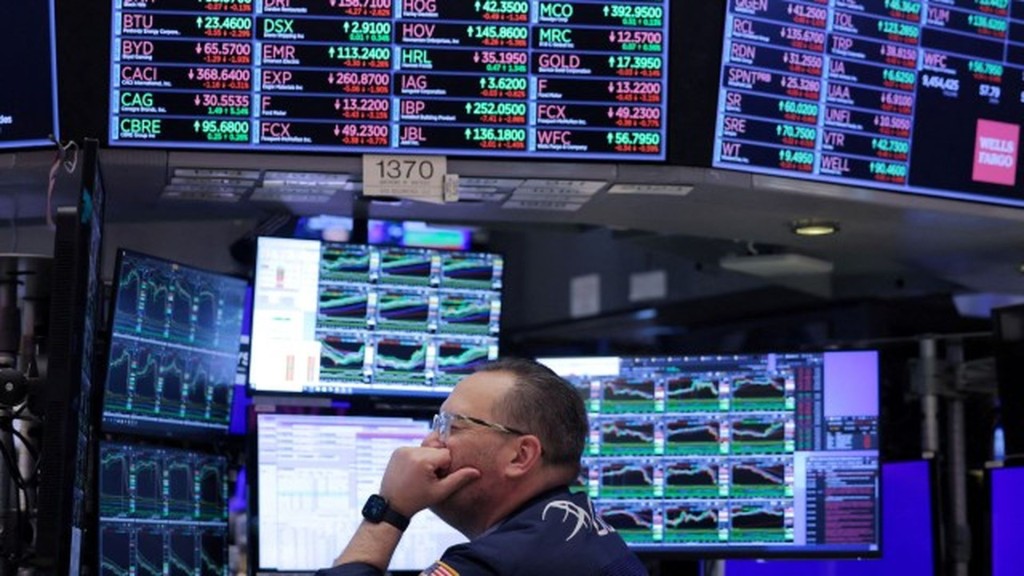
US stocks fell on Wednesday as oil prices climbed above US$100 a barrel, Treasury yields rose to their highest level since late 2023 and investors turned cautious ahead of key inflation figures that could influence the Federal Reserve's next interest rate decision.
The S&P 500 dropped 0.48% to finish at 7,636.46 points, while the Nasdaq Composite fell 0.64% to 26,253.34. The Dow Jones Industrial Average lost 0.77%, closing at 52,381.02.
The selling came as Brent crude moved above US$100 a barrel, a level that tends to draw close attention from investors because sustained increases in energy costs can feed directly into inflation. Rising crude prices have intensified concerns about the outlook for consumer prices at a time when markets are already watching closely for signals about the Federal Reserve's next move.
Oil Prices Put Markets on Edge
The latest jump in oil prices followed growing concerns over global supplies and renewed tensions in the Middle East. The conflict involving the United States, Israel and Iran has entered its seventh month, raising fears that a wider regional confrontation could disrupt energy supplies.
For investors, the concern extends beyond the price of crude itself. More expensive oil can increase transportation, manufacturing and operating costs across the economy. Companies may eventually pass those costs on to customers, adding pressure to consumer prices.
That creates a difficult environment for financial markets. If inflation remains high or begins accelerating again, the Federal Reserve could face greater pressure to keep interest rates elevated or raise them further.
The energy sector was the only major S&P 500 sector to gain on Wednesday, rising 1.1%. Every other sector index declined.
The move showed how sharply the market was responding to the surge in crude prices. Energy producers can benefit when oil prices rise, while companies in other industries often face higher costs as fuel and transportation expenses increase.

Treasury Yields Reach Highest Level Since November 2023
Bond markets added another source of pressure for equities.
The yield on the benchmark 10 year US Treasury note climbed to its highest level since November 2023 after the Treasury Department announced plans to buy up to US$6 billion in government bonds with maturities between 10 and 20 years.
Some analysts had expected a larger purchase of between US$8 billion and US$10 billion. The smaller than expected amount contributed to investor concerns about the bond market and pushed yields higher.
Higher Treasury yields can weigh on stocks because government bonds are widely viewed as relatively low risk investments. When those bonds offer higher returns, investors may demand greater potential returns from equities before taking on the additional risk of owning shares.
Higher yields also affect companies and consumers by increasing borrowing costs. That can influence corporate investment, housing activity and spending, adding another factor for investors to consider when assessing economic growth.
"That's leaving markets a little concerned, particularly as we don't have a lot to go on in terms of earnings expectations until we start to get into third quarter reporting season," said Rob Haworth, senior investment strategist at US Bank Wealth Management in Seattle.
Inflation Data Takes Centre Stage
Investors are now turning their attention to two major inflation reports due later in the week.
The US Producer Price Index is scheduled for Thursday, followed by consumer price data on Friday. The figures could provide fresh clues about how inflation is behaving and whether the Federal Reserve is likely to change its approach to interest rates.
Markets are currently pricing in a 60% chance that the Federal Reserve will raise interest rates at its policy meeting next week.
That expectation puts added weight on the incoming inflation figures. A stronger than expected reading could reinforce expectations for tighter monetary policy, while softer data could ease some of the pressure on stocks and bonds.
Investors are also watching the figures because oil prices have moved sharply higher. If the increase in energy costs persists, markets will be assessing whether it could feed into broader inflation.
Apple Slips After Smartphone Launch
Apple shares declined 0.3% after the company held its first smartphone launch under new chief executive John Ternus.
The modest decline came despite the considerable attention surrounding the event and the company's leadership transition. Apple remains one of the largest companies in the US stock market, meaning even relatively small movements in its share price can influence major indexes.
Technology shares more broadly struggled during the session, contributing to the Nasdaq's decline.
Alphabet, the parent company of Google, fell 2.3% after announcing plans to invest at least US$15.1 billion in artificial intelligence infrastructure in Finland over the next two years.
The investment includes a major agreement involving the supply of nuclear power, reflecting the growing amount of electricity required to operate large artificial intelligence systems and data centres.

Meta Gains on AI Assistant
Meta provided one of the day's biggest boosts to the broader market.
Shares of the social media company jumped more than 6% after it introduced a long anticipated artificial intelligence assistant capable of carrying out tasks on behalf of users.
The company said the assistant can autonomously perform activities such as sending emails, selling a car and arranging travel bookings.
Meta's gain helped limit the S&P 500's overall decline. The rise also demonstrated how strongly investors continue to respond to developments involving artificial intelligence, even as concerns about the cost of building AI infrastructure remain widespread across the technology sector.
The semiconductor sector also ended higher. The Philadelphia Semiconductor Index gained 0.37%, while Advanced Micro Devices rose 3%.
Dow Component Dow Falls on Partnership Report
Shares of Dow fell 0.6% after Bloomberg News reported that the chemicals company was considering withdrawing from its US$20 billion partnership with Saudi Aramco.
The reported possibility of an exit added pressure to the stock as investors assessed the potential implications for the company's strategy and its relationship with the Saudi energy giant.
The move stood out against the broader strength in energy related stocks, which benefited from the sharp rise in oil prices.
Market Breadth Points to Widespread Weakness
The decline was broad rather than being confined to a handful of major companies.
Within the S&P 500, declining stocks outnumbered advancing stocks by a ratio of 4.1 to one. The index recorded seven new 52 week highs compared with 25 new lows.
The Nasdaq showed an even wider gap. It recorded 41 new highs and 170 new lows.
Trading volume was relatively light. About 14.7 billion shares changed hands across US exchanges, compared with an average of 14.9 billion shares over the previous 20 trading sessions.
The figures suggest that investors were broadly cautious rather than engaging in a major rush to exit the market. Still, the number of declining stocks showed that weakness extended well beyond the headline indexes.
S&P 500 Remains Higher for the Year
Despite Wednesday's losses, the S&P 500 remains up about 12% in 2026.
The index is also around 2% below its record closing high reached on August 13. That leaves the broader market with substantial gains for the year, even as investors confront renewed concerns over energy prices, inflation, interest rates and geopolitical tensions.
The immediate focus now shifts to the inflation reports due Thursday and Friday. Their results could influence expectations for the Federal Reserve's next policy decision and determine whether the recent rise in Treasury yields and oil prices becomes a temporary market shock or a more persistent source of pressure.
Will the latest inflation figures ease concerns over higher interest rates, or will rising oil prices add another reason for investors to prepare for tighter monetary policy?