

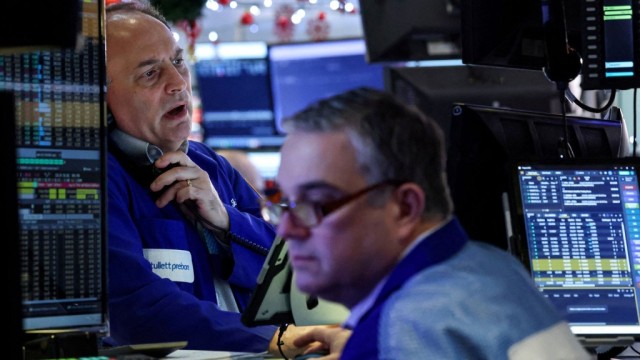
Wall Street rebounded sharply on Monday as renewed confidence in artificial intelligence sent technology shares higher, pushing the Nasdaq to a record closing level while falling Treasury yields and lower oil prices eased some of the pressure that had weighed on investors.
The Nasdaq Composite rose 2.26% to 27,122.09, marking its first record close since June 2. The S&P 500 gained 1.49% to finish at 7,764.70, leaving it about 0.4% below its August 13 record. The Dow Jones Industrial Average also advanced, rising 0.71% to 52,048.83.
The strongest gains came from technology and semiconductor companies, with investors once again betting that corporate spending on artificial intelligence has further room to grow. Advanced Micro Devices rose about 10% and briefly pushed its market value above $1 trillion, while Intel jumped 12.2% and Arm Holdings gained 17%. The Philadelphia Semiconductor Index climbed 4.3%.
AI Optimism Returns to Wall Street
The rally marked a sharp change in tone for technology stocks after a difficult period in which investors had begun questioning the scale and long term returns of corporate AI spending.
Warnings from leaders of major AI companies the previous week had contributed to a global technology selloff, with concerns about the risks associated with increasingly powerful systems weighing on sentiment. Monday’s trading showed that those concerns had not erased investor interest in companies positioned to benefit from continued spending on computing infrastructure and AI services.
AMD emerged as one of the clearest symbols of the renewed enthusiasm. The chipmaker’s shares reached a record level and lifted its market capitalisation above $1 trillion for the first time.
Investors have increasingly viewed AMD as a major competitor to Nvidia in the market for graphics processors used in AI computing. The company has also expanded beyond individual chips, offering systems that combine processors, networking equipment and other hardware.
That broader strategy has strengthened expectations that AMD can capture a larger share of spending as technology companies continue building data centre capacity.

Semiconductor Stocks Lead the Advance
Intel and Arm added to the strength across the chip sector.
Intel shares rose 12.2%, while Arm Holdings gained 17%, helping lift the broader semiconductor index by 4.3%. The gains suggested that Monday’s rally was not limited to one company but reflected a wider return of investor interest in AI and semiconductor stocks.
The move also came as investors assessed whether recent concerns about excessive AI investment had been overstated.
Big technology companies have continued committing large sums to data centres, processors and AI infrastructure. That spending has supported expectations for future earnings across parts of the technology industry, even as investors remain concerned about the amount of capital required to maintain the pace of development.
According to LSEG data, the S&P 500 traded at just under 19 times expected earnings on Friday, its lowest valuation since 2023. AI related companies have accounted for much of the recent increase in earnings expectations.
Meta Shares Jump on AI Push
Meta Platforms was another major contributor to Monday’s technology rally.
The social media company’s shares jumped 11.4% after Wells Fargo raised its price target following the launch of its Muse AI assistant. The move added to the broader view that companies investing heavily in AI could continue to attract investors if those investments translate into new products, revenue and stronger earnings.
Communication services stocks led the S&P 500 sectors, gaining 4.16%. Information technology followed with a 2.4% advance.
Eight of the S&P 500’s 11 sector indexes finished higher, showing that the rally extended beyond a small group of technology companies. Even so, the biggest moves were concentrated among companies with direct links to AI, semiconductors and digital services.

Treasury Yields Fall Below 5%
Falling Treasury yields also helped create a more supportive environment for stocks.
The benchmark US 10 year Treasury yield moved below 5%, a level that investors have been watching closely because higher bond yields can make equities less attractive and raise borrowing costs across the economy.
Art Hogan, chief market strategist at B. Riley Wealth, said investors had become accustomed to watching oil prices and the 10 year Treasury yield as important signals for the stock market.
“We've been kind of programmed to follow the price of oil and the yield on the US 10 year,” Hogan said. He said the two had shifted from being headwinds to providing support for stocks in the near term.
The move in yields came only days after the Federal Reserve raised interest rates for the first time in three years as it seeks to contain inflation.
Investors remain focused on what comes next. CME’s FedWatch tool indicated that traders saw roughly a 50% chance of another rate increase next month. At least 10 central bank policymakers are also scheduled to speak during the week, giving markets a series of opportunities to reassess the likely direction of US monetary policy.
Oil Prices Retreat as Middle East Talks Draw Attention
Crude prices provided another source of relief for investors.
Brent crude futures briefly fell below $100 a barrel, reaching their lowest level since September 9, before settling at $100.34. The decline came amid speculation that diplomatic discussions during the United Nations General Assembly could produce progress on tensions involving the Middle East.
US President Donald Trump said he would be willing to meet Iranian President Masoud Pezeshkian, who is expected to attend the UN General Assembly in New York.
The comments came after Washington and Tehran exchanged threats over the weekend. For financial markets, the possibility of diplomatic progress offered some relief because lower oil prices can reduce pressure on inflation and, in turn, reduce concern about further interest rate increases.
The relationship between oil prices, inflation and bond yields has become particularly important for investors in recent weeks. Rising energy costs can feed into consumer prices, potentially making it harder for the Federal Reserve to ease monetary policy.
Monday’s decline in crude prices therefore offered investors another reason to return to riskier assets.
China US Summit Adds Another Market Focus
Investors are also preparing for a meeting between Trump and Chinese President Xi Jinping on Thursday.
The summit could address several issues affecting financial markets, including trade relations, artificial intelligence and the ongoing conflict involving Iran. Discussions could also cover the extension of the existing US China trade truce.
A report said Washington had proposed extending the truce by six months, while Beijing was seeking a longer extension. Any agreement could have implications for companies exposed to tariffs, supply chains and technology restrictions.
AI regulation is expected to remain another important issue. The two countries are competing aggressively in advanced computing and artificial intelligence, while restrictions involving semiconductor technology have already become an important part of US China economic relations.
For technology investors, the outcome of discussions between the two governments could therefore matter almost as much as the latest corporate earnings figures.
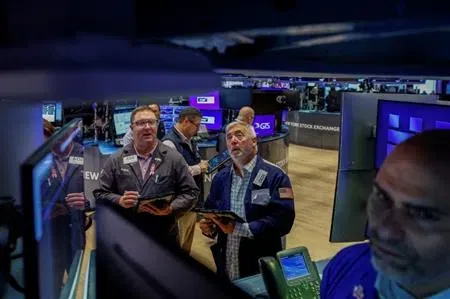
Bitcoin Rallies Alongside Risk Assets
Bitcoin also joined the broader risk rally.
The cryptocurrency rose more than 6% to reach its highest level in more than seven months. The move lifted shares of companies closely tied to digital assets, including Coinbase and Strategy.
Bitcoin is often watched by investors as an indicator of appetite for riskier assets. Its rise alongside technology stocks suggested that Monday’s improvement in market sentiment extended beyond traditional equities.
US listed companies with exposure to Greenland also posted large gains after progress in diplomatic negotiations between the United States and Denmark concerning Greenland’s status.
Greenland Mines tripled in value, while Greenland Energy more than doubled, although those moves came from relatively small companies and should not be compared directly with the gains in major S&P 500 stocks.
Paramount Skydance Falls on Merger News
Not every company benefited from the broader rally.
Paramount Skydance fell almost 3% after a source said the company had reached a settlement with California and 11 other states that had sued to block its proposed $110 billion merger with Warner Bros Discovery.
The decline stood out against the broader advance across US markets and reflected the importance of company specific developments even when overall investor sentiment is strong.
Market breadth was generally positive. Advancing stocks outnumbered declining shares within the S&P 500 by about 1.4 to one.
The S&P 500 recorded seven new highs and 29 new lows, while the Nasdaq recorded 64 new highs and 127 new lows. Trading volume remained strong, with 16.5 billion shares changing hands on US exchanges compared with an average of 16.2 billion shares over the previous 20 sessions.
Investors Face a Packed Week
Monday’s rally has placed AI stocks, interest rates, oil prices and international diplomacy at the centre of the market outlook.
The Nasdaq’s record close showed how quickly investor sentiment can shift when falling yields and lower energy prices coincide with renewed confidence in technology spending. But the Federal Reserve’s rate path remains uncertain, while developments involving Iran and the United States, as well as the upcoming Trump Xi meeting, could produce fresh volatility.
For now, investors have returned to AI stocks with renewed confidence. The next test will be whether corporate spending, earnings growth and economic conditions continue to support the valuations behind the rally.
Will continued AI investment and easing Treasury yields keep Wall Street’s technology rally moving higher, or will interest rates and geopolitical risks once again take centre stage?