

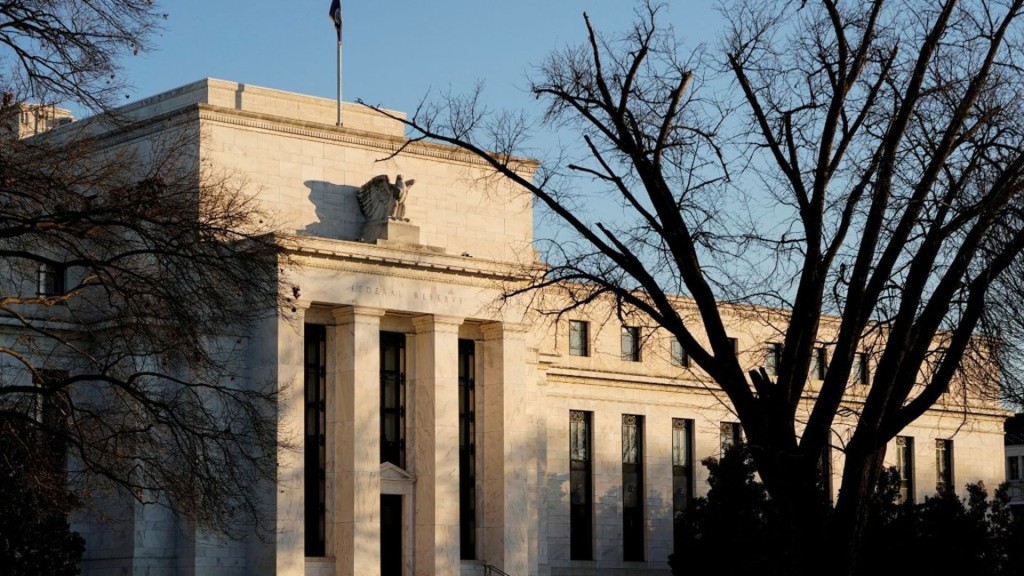
The Federal Reserve raised its benchmark interest rate by a quarter percentage point on Wednesday and signalled that borrowing costs could rise again as policymakers confront inflation that has remained well above their 2 percent target.
The unanimous decision lifted the federal funds target range to 3.75 percent to 4 percent. New economic projections showed that most policymakers expect another increase before the end of the year, while the central bank also raised its forecast for inflation in 2026.
The decision marked the first rate increase since July 2023 and the first major policy move under Federal Reserve Chairman Kevin Warsh, who took office in late May after being selected by President Donald Trump. Warsh had faced pressure from Trump to reduce borrowing costs, but Wednesday’s decision showed the central bank was prepared to move in the opposite direction while inflation remains elevated.
Fed Takes Tougher Line on Inflation
The Federal Reserve said inflation remains too high and argued that the latest increase would help bring price growth back to its 2 percent objective more quickly.
“Today's policy action will support a timelier return to the Committee's 2 percent goal,” the central bank said in its statement following a two day policy meeting. The decision passed unanimously by a 12 to 0 vote.
The Fed’s latest projections provide a clearer picture of how officials see the path ahead. The median projection puts the federal funds rate at about 4.1 percent at the end of 2026, with the same median rate projected for the end of 2027. The median then falls to 3.9 percent in 2028 and 3.6 percent in 2029.
The projections do not amount to a promise of future rate moves. Fed officials make their forecasts independently, and economic conditions can change between meetings. But the figures show that policymakers are preparing for interest rates to remain relatively high for longer than previously expected.
The September projections also showed that 16 of the 18 officials who submitted rate forecasts expect at least one further increase this year, while two see rates remaining at the current level.
Warsh did not submit a rate projection, as he had also refrained from doing so previously. That leaves the rate projections of the other policymakers as the main guide to how the committee sees the likely direction of policy.
Inflation Forecast Raised
The Fed also raised its inflation outlook.
Officials now expect inflation, measured by the Personal Consumption Expenditures Price Index, to reach 3.7 percent in 2026, compared with the 3.6 percent forecast issued in June. The median projection falls to 2.3 percent in 2027 and 2.1 percent in 2028 before reaching 2 percent in 2029.
The latest forecast means policymakers no longer expect inflation to return to the central bank’s 2 percent target as quickly as previously projected.
That matters because the Fed’s decisions on interest rates are closely tied to the pace at which price pressures are easing. If inflation stays above target for longer, officials have less room to reduce borrowing costs without risking another period of accelerating prices.
The central bank also raised its forecast for core PCE inflation, which excludes food and energy prices. The median projection for core inflation stands at 3.4 percent for 2026, 2.5 percent for 2027 and 2.2 percent for 2028 before returning to 2 percent.
Those figures point to persistent price pressures even after taking out some of the most volatile components of the inflation data.
Warsh Faces Close Market Attention
Warsh’s role has attracted particular attention because Wednesday’s increase was the first major policy decision since he became Fed chair.
Trump had selected Warsh with expectations that monetary policy could eventually move toward lower interest rates. Instead, the new chairman joined the unanimous decision to raise rates as officials responded to continuing inflation concerns.
Warsh has said the Fed should bring inflation back to 2 percent clearly and at a sufficient pace. His comments following the decision were therefore closely watched by investors looking for clues about whether another increase could come before the end of the year.
The Fed statement itself avoided giving a fixed timetable for future decisions. That approach is consistent with Warsh’s preference for making policy decisions based on incoming economic information rather than committing to a predetermined sequence of moves.
Markets nevertheless reacted to the prospect of additional tightening.
The US dollar strengthened against the euro after the announcement. Treasury yields remained elevated, with the 10 year Treasury yield trading around 4.96 percent after briefly moving above 5 percent earlier in the week. The 30 year Treasury yield also remained above 5.3 percent.
US shares moved higher following the announcement, with the S&P 500 gaining about 0.3 percent and the Nasdaq Composite rising about 0.7 percent in the immediate market reaction.
Investors are also watching expectations for the Fed’s next meeting. Market pricing showed the probability of another increase at the October meeting moving higher after Wednesday’s decision, according to the CME Group’s FedWatch Tool.

Economy Still Growing
The Fed’s decision came despite a generally solid assessment of the US economy.
Officials raised their median forecast for economic growth in 2026 to 2.3 percent from 2.2 percent in June. The projection for 2027 stands at 2.4 percent.
The labour market outlook also improved compared with the previous forecast.
The Fed now expects the unemployment rate to end 2026 at 4.1 percent, compared with the 4.3 percent forecast in June. Officials project the unemployment rate at 4.1 percent in 2027 and 2028, before a slight rise to 4.2 percent in 2029.
The combination of continued economic growth and relatively stable employment gives policymakers more room to focus on inflation.
The Fed’s latest policy statement said economic activity was expanding at a solid pace, while domestic spending remained resilient. It also pointed to strong productivity growth and robust capital investment.
Those conditions make the policy decision different from an emergency response to a weakening economy. Instead, the central bank is raising borrowing costs while growth continues in an effort to prevent inflation from becoming entrenched.
Higher Rates Reach Consumers
The effects of the Fed’s decision extend well beyond financial markets.
Higher benchmark interest rates can increase borrowing costs for households and businesses. Mortgage rates, credit card rates, business loans and other forms of financing can all respond to changes in monetary policy and Treasury yields.
The US housing market is particularly sensitive to movements in long term borrowing costs. The average rate on a 30 year fixed mortgage has been approaching 7 percent, increasing the cost of purchasing a home for borrowers who need financing.
Businesses also face higher costs when they borrow to expand operations, purchase equipment or finance investment. Companies that rely heavily on debt can see their interest expenses rise as borrowing conditions tighten.
At the same time, savers can benefit from higher interest rates on some deposits and fixed income investments.
The policy challenge for the Fed is therefore not limited to reducing inflation. Officials must also judge how much pressure higher rates are placing on economic activity and employment.

Energy Prices Add to Inflation Concerns
The inflation problem has also become more complicated because of higher energy costs.
The original account of the Fed decision pointed to the impact of rising energy prices following the outbreak of war involving the United States, Israel and Iran. Higher oil prices can feed through to transportation, manufacturing and household expenses, making it more difficult for inflation to return quickly to the Fed’s target.
The central bank’s statement did not assign the current inflation situation solely to temporary supply problems. Instead, officials focused on the broader fact that inflation remains elevated while economic activity and investment continue at a solid pace.
The Fed also said uncertainty remains high because of geopolitical developments.
For policymakers, the challenge is deciding how much of the current inflation pressure will fade and how much could persist through the wider economy.
What Comes Next
The September decision gives markets a clear indication that the Fed is not finished tightening monetary policy.
The median projections point to a federal funds rate of about 4.1 percent at the end of both 2026 and 2027. That is higher than the projections released in June, when the median year end rate was 3.8 percent for 2026 and 3.6 percent for 2027.
The inflation outlook has moved in the opposite direction. Officials now see PCE inflation at 3.7 percent this year, compared with 3.6 percent in June, and expect the 2 percent target to be reached only in 2029.
That combination leaves the next policy meetings highly dependent on incoming inflation, employment, energy and economic growth data.
For households, companies and investors, the immediate question is whether the September increase will be followed by another move later this year. With most Fed policymakers already projecting at least one more increase, the next major inflation and employment reports will provide the evidence markets need to assess what comes next.