

China and Hong Kong stocks fell on Tuesday as disappointing signs from the domestic economy outweighed a rebound in artificial intelligence related shares. Investors reacted cautiously to a mixed set of August figures that showed industrial production gaining some momentum while consumer spending and investment remained under pressure.
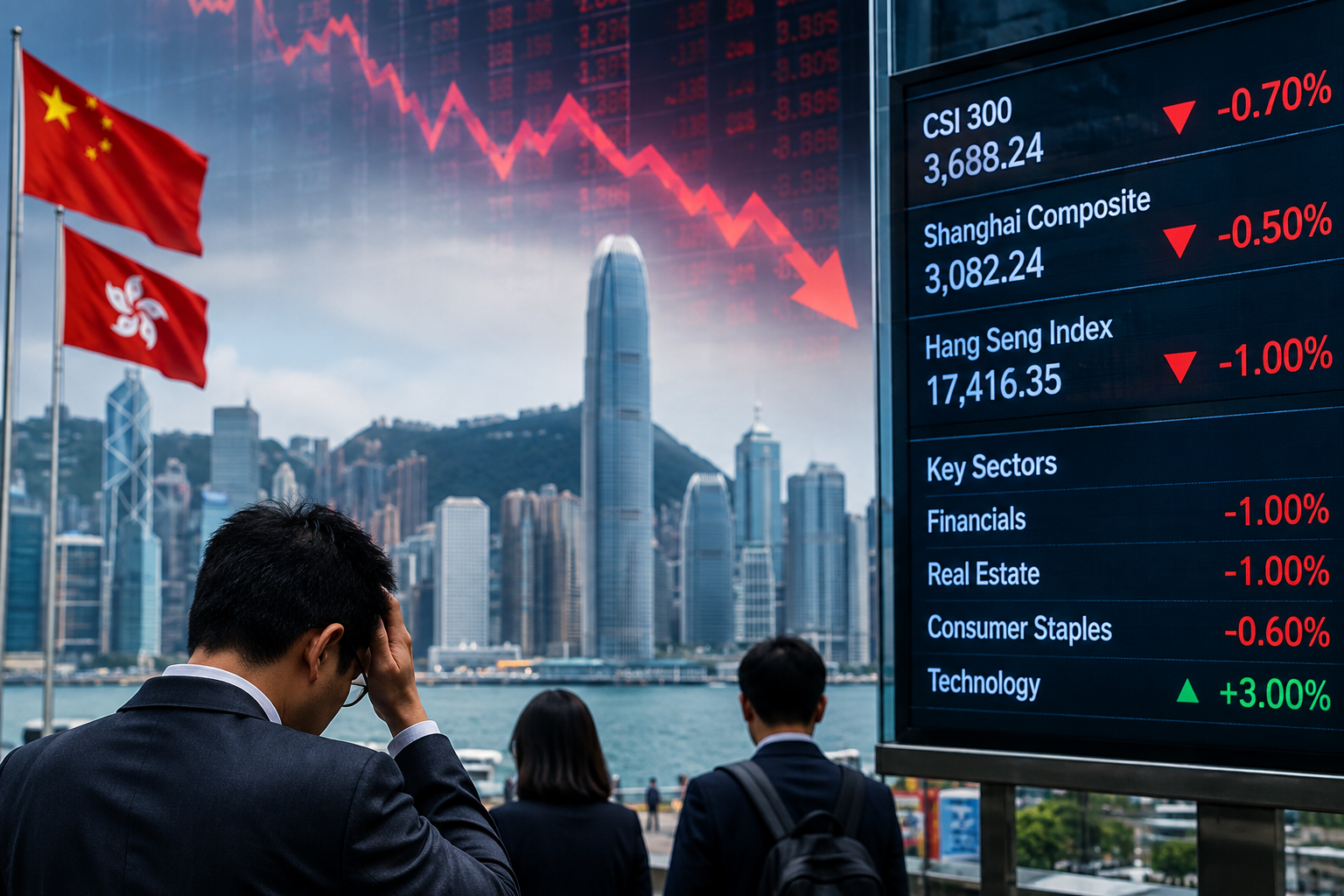
The blue chip CSI300 Index ended 0.7 percent lower, while the Shanghai Composite Index declined 0.5 percent. In Hong Kong, the Hang Seng Index dropped 1 percent as investors reduced exposure to financial, property and consumer companies.
The latest figures added to concerns that China's economic recovery remains uneven. Industrial output improved in August, but weaker consumption and a deeper decline in investment suggested that businesses and households are still reluctant to increase spending.
The property market provided another source of concern. New home prices fell again during August, extending a prolonged period of weakness that continues to weigh on confidence, household wealth and construction activity.
Industrial Growth Fails to Lift Sentiment
China's industrial output accelerated in August, offering one of the few positive elements in the latest batch of economic data. The improvement suggested that factories continued to receive support from manufacturing activity even as other parts of the economy struggled.
Investors, however, were more focused on what the data said about domestic demand.
Consumer spending remained sluggish, while the investment downturn worsened. That combination raised questions about how much momentum the world's second largest economy can generate without stronger demand from households and private businesses.
The figures also arrived after weaker than expected credit demand, adding another concern for economists and investors assessing the health of the recovery.
Barclays analysts said in a note that the August activity figures reinforced their view that a recovery in domestic demand remained difficult to identify. The bank maintained its below consensus forecast for China's gross domestic product growth in 2026 at 4.5 percent.
The assessment reflects a broader concern among investors: industrial production can remain relatively resilient even while households remain cautious and companies delay major investment decisions.
That imbalance makes the economic picture more complicated. Factory activity may receive support from exports, government policies or selected technology industries, but those gains do not necessarily translate into stronger spending across the wider economy.
China and Hong Kong stocks fell as weak consumer demand, declining property prices and slowing investment raised fresh concerns about the strength of the economic recovery. Technology and semiconductor shares rebounded, but broader market sentiment remained under pressure.

Property Market Remains Under Pressure
China's housing market continued to weigh on sentiment after new home prices declined again in August.
The property sector has faced years of pressure following a prolonged debt crisis among developers, falling home sales and weaker confidence among buyers. The sector remains closely tied to household wealth, construction activity and demand for related goods and services.
For investors, another month of falling home prices suggests that the property market has yet to establish a durable recovery.
The weakness was reflected in Tuesday's trading. The CSI 300 Financial Index fell around 1 percent, while the CSI 300 Real Estate Index also lost about 1 percent.
Consumer staple shares declined 0.6 percent.
The market reaction showed that investors were not treating the latest economic figures as an isolated setback. Instead, the data fed into existing concerns about several parts of the economy moving at different speeds.
A stronger industrial sector cannot fully offset weak property activity if households remain cautious about spending. Similarly, government support measures may provide temporary relief without producing a sustained improvement in private sector confidence.
Technology Shares Provide a Rare Bright Spot
Technology stocks offered some relief from the broader market decline.
The tech focused STAR50 Index rose as much as 3 percent during the session, marking its first rebound in a week after falling to a four and a half month low.
The CSI Semiconductor Material and Equipment Thematic Index climbed 3.2 percent, showing renewed interest in companies linked to China's semiconductor ambitions.
The gains came as investors returned to selected technology stocks after a period of heavy selling. Earlier in the year, artificial intelligence related shares had helped drive a powerful rally across parts of the Chinese equity market.
That rally eventually prompted investors to lock in profits, leaving some technology stocks sharply lower from their earlier highs.
Tuesday's recovery therefore appeared selective rather than broad based. Investors were willing to buy companies exposed to areas such as semiconductors and artificial intelligence, even while remaining cautious about financials, property developers and consumer companies.
In Hong Kong, major technology stocks fell 0.6 percent overall. Tencent gained nearly 2 percent, providing some support to the sector and limiting the extent of losses among technology names.
Shares of Guangdong Tianyu Semiconductor rose more than 7 percent after the company announced a share buyback plan.
The response to the buyback showed how corporate actions can still attract investors even when wider market sentiment is weak. A buyback can signal that company management considers its shares undervalued, while also reducing the number of shares available in the market.
Liquidity Concerns Add to Investor Caution
Market conditions have also changed significantly since the technology led rally earlier this year.
Onshore investor sentiment has weakened over the past month as traders took profits following the record breaking advance in artificial intelligence related shares. The shift has been accompanied by weaker liquidity.
Daily turnover in mainland Chinese shares remained close to its lowest level since April during the past week.
Lower trading activity matters because it can make markets more sensitive to economic news. When fewer investors are actively trading, a disappointing economic figure can trigger sharper moves in individual sectors as investors reassess expectations.
The reduced turnover also suggests that some investors are choosing to wait rather than make aggressive bets on a recovery.
That caution is understandable given the conflicting signals in the economic data. Industrial production is improving, but consumption remains weak. Property prices continue to fall, while investment is deteriorating. Technology stocks have attracted renewed interest, yet the broader market has lost momentum.
For investors, the central question is whether stronger industrial activity can eventually spread into household consumption and private investment.
Investors Watch for Evidence of Stronger Demand
China's policymakers have introduced a range of measures over recent years aimed at supporting growth, stabilising the property market and encouraging domestic consumption. Yet the latest figures suggest that confidence has not fully recovered.
The weakness in domestic demand is particularly important because a sustained economic recovery requires more than factory output. Households need to feel confident enough to spend, companies need reasons to invest and the property sector needs greater stability.
The latest figures provide little evidence that all three conditions have been met.
That leaves investors watching upcoming economic releases for signs that consumption and investment are beginning to improve. Any sustained increase in household spending could provide a stronger foundation for growth, while a stabilisation in property prices could help restore confidence.
Until then, market performance is likely to remain sensitive to individual sectors and corporate developments rather than being driven by a broad improvement in economic expectations.
Tuesday's session captured that divide clearly. Technology and semiconductor shares attracted buyers, while financial, property and consumer stocks struggled. The broader market still reflected uncertainty over the strength of China's domestic recovery.
For Hong Kong and mainland Chinese equities, the next test will be whether improving industrial activity can translate into stronger demand from households and businesses. Do you think China's technology sector can continue to outperform while the wider economy remains under pressure?