

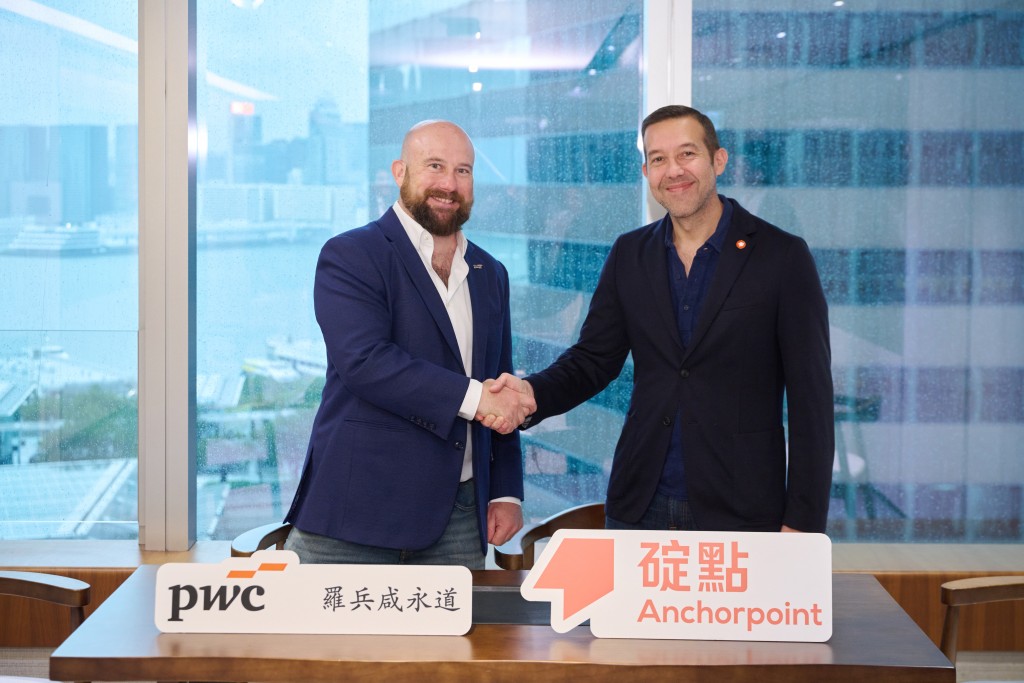
Anchorpoint Financial has joined forces with PwC Hong Kong to establish a new programme aimed at expanding education, research and industry discussion around tokenised money in Hong Kong.
The Tokenised Money Adoption Program was announced on Tuesday, with PwC Hong Kong becoming its inaugural strategic partner under a Memorandum of Understanding. The partnership brings together Anchorpoint's work in regulated digital money with PwC's industry experience and research capabilities as the two organisations seek to encourage wider understanding of how tokenised money could be used across financial and corporate activities.
The initiative comes after Anchorpoint began beta access for HKDAP, its regulated Hong Kong dollar backed stablecoin. With the product entering its beta phase, the company said there is a growing need for informed discussion about how tokenised money can be issued, operated and applied in practical settings.
Rather than focusing solely on the technology behind digital money, the new programme is designed to bring different parts of the financial and business community into the same conversation. Participants are expected to include stakeholders from financial services, payments, technology, digital assets and the corporate sector.
The programme will use workshops, research projects and industry discussions to examine the opportunities and challenges surrounding tokenised money and its potential applications.
PwC Hong Kong Joins as First Strategic Partner
PwC Hong Kong will support the programme as its first strategic partner under the newly signed Memorandum of Understanding.
According to the announcement, the accounting and professional services firm will contribute industry experience and insights to the programme's education and research work. Its involvement is intended to add practical industry perspectives to discussions that can otherwise become heavily focused on the technical side of digital assets.
For companies considering tokenised financial products, understanding the technology is only one part of the equation. Questions around how such products operate, how users interact with them and how businesses can apply them are equally important.
That is where the new programme intends to focus.
Anchorpoint said the initiative will create opportunities for stakeholders to examine tokenised money through education, research and practical industry discussion. The goal is to build a stronger understanding of the products and services that can be developed around tokenised forms of money.
The partnership also reflects the increasingly broad range of sectors that may have an interest in digital forms of currency. Payments companies, financial institutions, technology firms and businesses may approach tokenised money from different perspectives, making common standards and shared understanding an important part of wider adoption.

Focus on Education and Practical Use
The first area of focus for the Tokenised Money Adoption Program will be education and enablement.
This part of the programme is intended to help stakeholders better understand tokenised products and services. As digital money develops, companies need to consider not only what a product can do but also how it fits into existing financial and commercial processes.
Education can help close that gap by giving businesses and other participants a clearer understanding of how tokenised money works and where it could be used.
The programme's second focus will be research and development of technical and market standards.
Standards can play an important role when different companies and sectors are exploring a new form of financial infrastructure. Without shared approaches, businesses may face uncertainty when assessing how products should operate or interact with other systems.
The programme will therefore examine technical and market standards as part of its research activities. The stated aim is to contribute to discussions that can help shape a clearer framework for tokenised money products and services.
The third area will be the exploration of real world use cases.
This shifts the discussion from theory to practical application. Instead of examining tokenised money only as a financial technology concept, participants will consider how it could potentially be used in actual business and financial settings.
That approach could give the programme a broader role within Hong Kong's digital asset sector by bringing together organisations with different experiences and commercial priorities.
HKDAP Enters Beta Phase
The launch of the programme follows the commencement of beta access for HKDAP, Anchorpoint's Hong Kong dollar backed stablecoin.
The timing is significant for the company because beta access gives Anchorpoint an opportunity to move discussions around tokenised money closer to actual product use. The company said the launch of the programme reflects the need for greater industry discussion around the use, operation and application of tokenised money.
Stablecoins are designed to maintain a stable value against a reference asset, with Hong Kong dollar backed products using the local currency as their reference. In the case of HKDAP, Anchorpoint describes the product as a regulated Hong Kong dollar backed stablecoin.
The introduction of a product such as HKDAP also raises practical questions for businesses and financial professionals. These include how tokenised money could fit into payment processes, how companies might use such products and what standards may be required for broader commercial adoption.
The new programme is intended to provide a setting in which those questions can be examined through research and industry dialogue.
Bringing Different Industries Together
One of the programme's defining features will be its cross sector approach.
Financial services firms may view tokenised money through the lens of financial products and transactions. Payments companies may be more interested in how digital forms of money can be incorporated into payment systems. Technology firms may focus on infrastructure and technical standards, while corporate users may be interested in practical commercial applications.
The programme plans to bring these groups together through workshops, research initiatives and industry discussions.
That broad participation could help ensure that conversations about tokenised money are not confined to digital asset companies. Its development involves questions that extend across finance, payments, technology and corporate activity.
For Anchorpoint, the programme also provides a platform to build greater awareness around the use of regulated tokenised money as HKDAP progresses through its beta phase.
For PwC Hong Kong, participation provides an opportunity to contribute its industry knowledge to research and education efforts focused on an emerging area of financial technology.
Three Areas Set the Programme's Direction
The programme's work will be organised around three main areas.
The first is education and enablement of tokenised products and services. This will focus on improving understanding and helping stakeholders assess how tokenised money can be used.
The second is research and development of technical and market standards. This will examine the approaches needed to support the development and operation of tokenised money products.
The third is the exploration of real world use cases. This will focus on how tokenised money could move beyond discussion and be considered for practical applications across relevant industries.
Together, the three areas give the initiative a broad remit covering knowledge, standards and application.
The programme's launch also comes at a point when Anchorpoint is moving HKDAP into beta access, giving greater urgency to discussions about how regulated tokenised money can operate in practice.
The partnership between Anchorpoint and PwC Hong Kong will now put those questions into a wider industry forum, with financial services, payments, technology, digital asset and corporate stakeholders invited to participate in the discussion.
As Hong Kong's tokenised money sector develops, will stronger education, common standards and practical use cases be enough to turn interest in digital money into wider business adoption?