

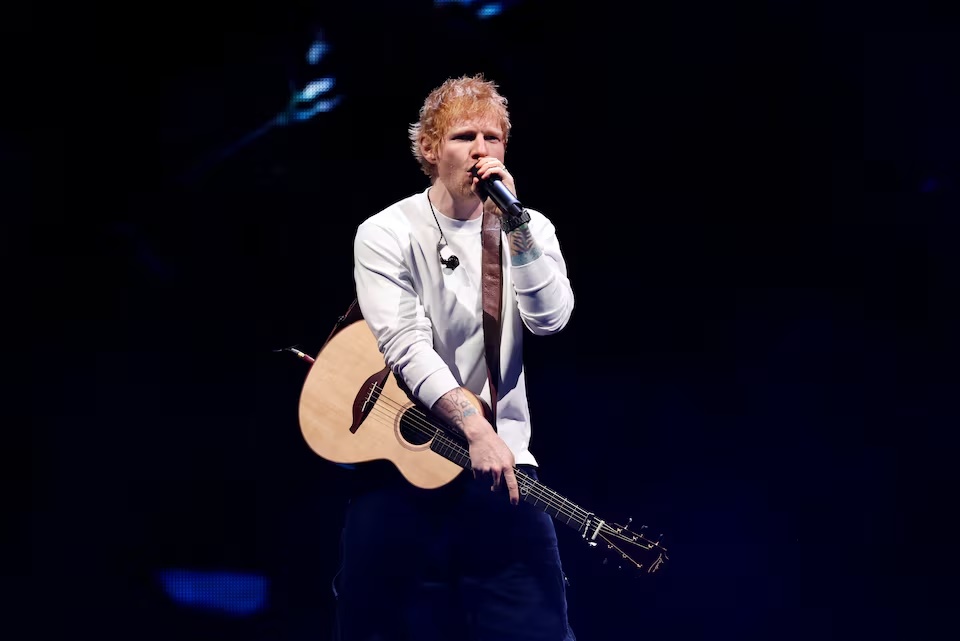
Ed Sheeran’s US Loop Tour has been thrown into a widening dispute over Gaza after rapper Macklemore was removed from the tour and the remaining opening acts withdrew in protest, forcing the British singer to defend a position he has long described as non political.
The controversy has spread beyond the concert stage. Finneas, Danish band Lukas Graham, Irish singer Aaron Rowe and Irish group Beoga have all pulled out of the tour, while artists and commentators have publicly criticised the decision to remove Macklemore after his pro Palestinian remarks during performances at New Jersey’s MetLife Stadium.
Sheeran has said the decision was made by the tour promoter and venues, rather than by him personally. He said he respected Macklemore’s right to express his views but had been caught between competing demands from the venues hosting his concerts.
The dispute has now become one of the most prominent recent examples of the Israel Gaza conflict spilling directly into the commercial music industry, where artists, promoters, venue owners and audiences are increasingly being forced to confront political questions surrounding live performances.
Macklemore’s MetLife Remarks Trigger Dispute
The immediate controversy began after Macklemore performed at MetLife Stadium in East Rutherford, New Jersey, on September 4 and 5.
During his performances, the rapper spoke in support of Palestinians and urged the audience to remember people in Gaza and the occupied West Bank. His remarks included a call for a free Palestine and a performance of his protest song “Hind’s Hall”, which was written in response to the war and pro Palestinian student demonstrations.
The comments drew both support and criticism.
The Israeli American Council called for Macklemore to be removed from Sheeran’s tour, while other public figures criticised aspects of his remarks. The controversy intensified when the rapper was subsequently removed from the remaining US dates of the Loop Tour.
Macklemore later said that venue owners had put pressure on Sheeran and the tour team to remove him. He specifically named Robert Kraft, whose Kraft Group owns Gillette Stadium in Massachusetts, as one of the people involved.
According to Macklemore, Kraft told Sheeran that Macklemore would not be allowed to perform at Gillette Stadium and that other venue owners had also objected to his participation.
Those claims became central to the dispute, although the precise involvement of individual venues differed. Kraft confirmed that Macklemore would not perform at Gillette Stadium and defended the decision by referring to the rapper’s previous controversies.
Sheeran subsequently explained that the promoter had been informed that some venues would not allow concerts to proceed with Macklemore on the bill.
Sheeran Says He Wanted to Avoid Politics
Sheeran responded publicly after the controversy escalated, saying he did not use his professional platform for politics.
He also said he had spoken with Macklemore and respected his conviction, while arguing that people could pursue the goal of peace through different approaches.
The position placed Sheeran in an increasingly difficult public debate. Critics argued that removing an artist because of political remarks amounted to allowing commercial interests to determine who could speak from a major concert stage.
Sheeran’s supporters, meanwhile, pointed to his explanation that he did not control the decisions of individual stadium owners and that cancelling the concerts could have affected hundreds of thousands of fans.
The promoter Messina Touring Group said venues on the US tour had indicated that they would not permit the concerts to go ahead if Macklemore remained on the lineup. According to the promoter, keeping him on the bill could therefore have resulted in cancellations affecting a large number of ticket holders.
That explanation has not ended the criticism.
Instead, it has shifted the focus to a larger question about how much control artists have over the political content of their own performances when they work within large commercial tours involving promoters, stadium operators and corporate partners.

Four Support Acts Walk Away
The fallout became significantly larger on September 15 when the remaining support acts announced that they would no longer perform on the tour.
Finneas, who is Billie Eilish’s brother and frequent collaborator, said he was withdrawing because he believed artists should not be silenced when speaking about people facing oppression.
Lukas Graham, Aaron Rowe and Beoga also announced their departures. Their decisions left Sheeran without the group of opening performers originally associated with the remaining US dates.
The withdrawals transformed what had initially been a dispute involving two artists into a broader argument among musicians about artistic freedom, political expression and responsibility.
For Sheeran, the timing was particularly significant. The Loop Tour is one of the major commercial concert operations of his career, with large stadium shows involving thousands of workers, venue staff, promoters and suppliers.
Cancelling dates would have had consequences far beyond the artists themselves.
But continuing the tour without the original support acts also created an unusual public spectacle. Rather than the controversy fading after Macklemore’s departure, each new withdrawal brought additional attention to the issue.
Gaza and the Music Industry
The dispute comes as the war in Gaza has become increasingly visible within the entertainment industry.
Since Hamas attacked Israel on October 7, 2023, followed by Israel’s military campaign in Gaza, musicians, actors, filmmakers and other public figures have repeatedly faced pressure to comment on the conflict.
Artists have taken sharply different positions. Some have publicly supported Palestinian rights and called for an end to Israel’s military campaign. Others have expressed support for Israel or focused on the safety of Jewish communities. Many have attempted to avoid political statements altogether.
The issue has appeared at major cultural events and award ceremonies, while artists have faced criticism, petitions and calls for boycotts over their statements or associations.
Julie Norman, a professor at University College London who studies the Israel Palestine conflict, told AFP that Palestine has become more prominent in public debate, particularly among younger people. She attributed part of that shift to the way the conflict has been experienced through social media, where images and accounts from Gaza have reached audiences around the world.
The result is a cultural environment in which remaining silent can itself become a subject of public debate.
Sheeran’s Record Complicates His Political Neutrality
Sheeran has presented himself as an artist who does not want to use his professional platform for politics. His supporters argue that he should be allowed to maintain that position.
His critics point to examples from his past that suggest the boundary has not always been absolute.
In 2022, Sheeran performed at a benefit concert supporting Ukraine after Russia invaded the country. He has also previously supported political and charitable causes in Britain, including Comic Relief.
In 2018, he was among public figures who signed an open letter concerning Brexit. He also spoke positively about former Labour leader Jeremy Corbyn in an interview with The Sunday Times in 2017.
Those earlier actions do not necessarily mean Sheeran has adopted a consistent political position. They do, however, make his current statement about avoiding politics a subject of discussion among critics.
Music writer Neil March, who teaches at the Institute of Contemporary Music Performance in London, told AFP that the idea of music being completely separate from politics is difficult to maintain because performers inevitably operate within social and political environments.
The debate is not simply about whether Sheeran personally supports Palestinian or Israeli political positions. It is also about whether an artist can remain politically neutral while making decisions about who appears on a concert stage and under what conditions.

Fans Are Now Caught in the Dispute
The controversy has also reached Sheeran’s audience.
Reports have emerged of fans attempting to resell tickets following the changes to the tour lineup. Some supporters have questioned whether they should receive refunds after purchasing tickets for shows that were advertised with particular opening performers.
For many ticket holders, the dispute is less about geopolitics than about what they paid to see.
The Loop Tour involves major stadium dates, extensive production arrangements and large numbers of people travelling to concerts. Any significant change to the lineup can affect expectations that were established when tickets went on sale.
At the same time, the public reaction demonstrates how quickly a dispute between performers can become a commercial issue for fans.
Macklemore Turns the Controversy Into a Campaign
Macklemore has continued to use the dispute to draw attention to Palestinian humanitarian causes.
He has pledged to donate his $1 million earnings from the Sheeran tour to organisations supporting Palestinians. He also challenged Kraft to make a matching contribution.
The move has shifted some of the discussion away from the tour itself and towards humanitarian assistance.
Sheeran has also said he supports humanitarian causes, and reports indicate that he has privately asked Kraft to contribute $2 million to aid efforts. Kraft has publicly described himself as committed to humanitarian causes, although the two men have approached the controversy from different positions.
The competing responses illustrate the difficult position facing major artists. A performer can attempt to keep politics away from a commercial concert, but decisions involving another artist’s political expression can quickly become political themselves.
A Bigger Question for Live Music
Sheeran’s immediate task is to continue the Loop Tour while managing the fallout from the Macklemore dispute.
The larger issue extends beyond one singer or one rapper.
Concerts increasingly involve complex relationships between artists, promoters, venue operators, sponsors and audiences. When political speech enters that system, responsibility becomes difficult to separate. One party may control the booking, another may control the venue, while the artist performing on stage may have little authority over the commercial arrangements surrounding the event.
For Sheeran, the dispute has tested his attempt to remain outside political arguments while maintaining a global touring operation.
For Macklemore, being removed from the tour has created another platform for his campaign over Palestinian rights.
For the artists who walked away, the decision has become a public statement about what they believe performers should be allowed to say.
For audiences, the controversy raises a straightforward question: when political expression becomes part of a concert dispute, should the artist, promoter or venue have the final say over who gets to stand on the stage?