

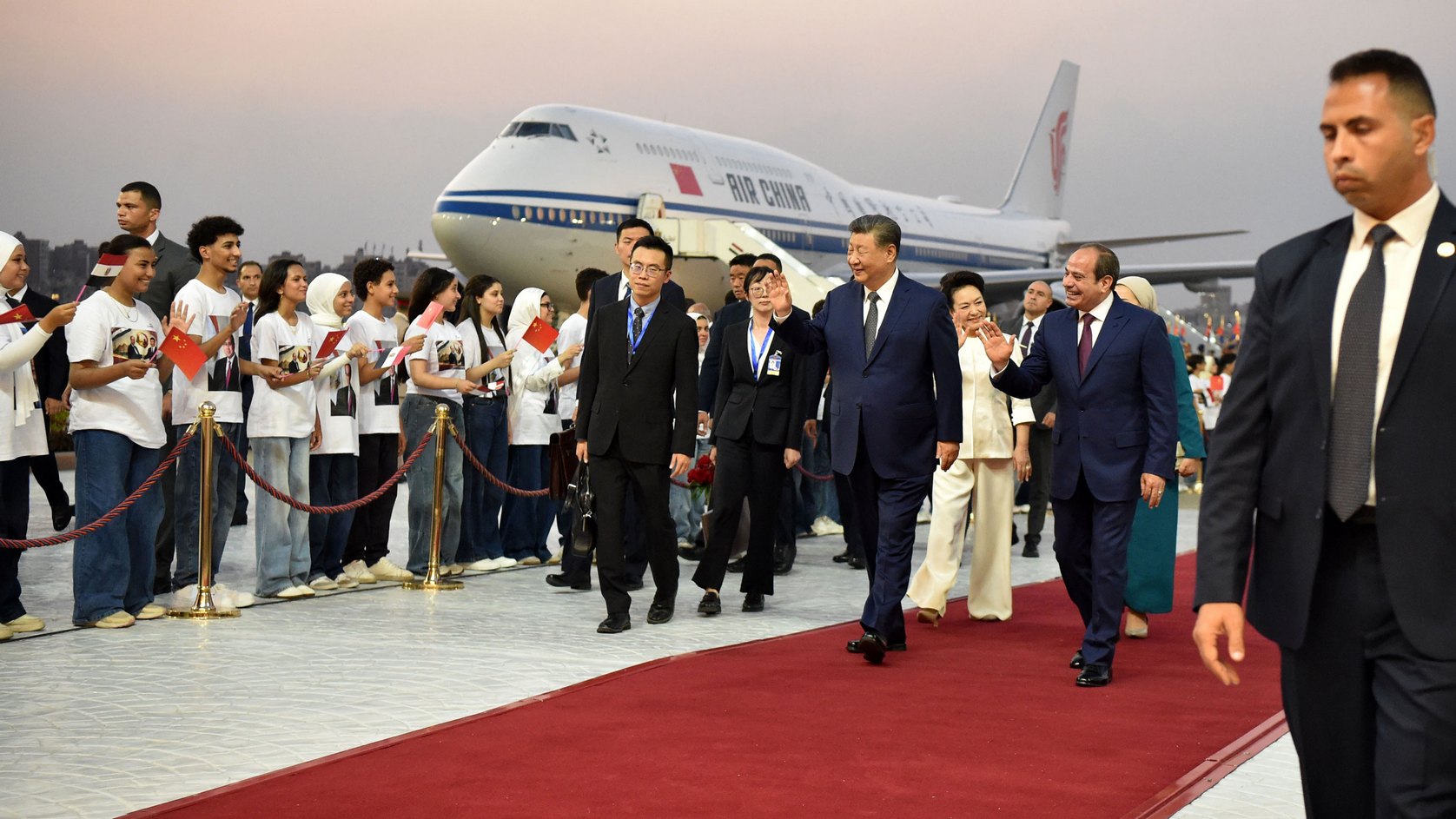
Chinese President Xi Jinping arrived in Cairo on Wednesday for his first visit to Egypt in a decade, holding talks with President Abdel Fattah al Sisi as Beijing seeks to strengthen its economic and strategic position in the Middle East.
Xi was formally received by Sisi at Ittihadiya Palace, where a 21 gun salute marked the start of the visit. The two leaders were expected to discuss the regional consequences of the US Iran war, threats to maritime trade and opportunities for expanding Chinese investment in Egypt.
The meeting comes at a sensitive moment for both countries. Egypt maintains close military and diplomatic relations with Washington, while China has steadily expanded its commercial presence in Egypt and built closer relations with countries across the Arab world.
The talks are also expected to produce a series of economic agreements covering artificial intelligence, transport and manufacturing. For Cairo, the visit offers an opportunity to attract further Chinese capital while demonstrating that Egypt intends to maintain relationships with competing global powers.
China’s growing economic presence in Egypt
China has become one of Egypt’s most important trading partners and investors, with Chinese companies involved in major infrastructure and industrial projects.
Egypt currently estimates Chinese investment in the country at around US$10 billion. Much of that investment is connected to large development projects, including the Suez Canal Economic Zone and the New Administrative Capital.
The Suez Canal Economic Zone has particular importance because of Egypt’s position on one of the world’s major maritime trade routes. The zone is intended to attract manufacturing, logistics and other industries by taking advantage of the canal’s location between major markets in Asia, Europe and Africa.
The continuing conflict between the United States and Iran has added another layer of uncertainty to global shipping. Any disruption affecting routes through the Middle East could have consequences for trade flows, transport costs and supply chains.
Chinese companies have already established interests in the Suez Canal Economic Zone, and further investment is expected as Beijing expands its commercial links with Egypt.
China’s role in Egypt also extends beyond industrial zones.
Beijing has provided substantial support for some of Sisi’s largest infrastructure projects, including the New Administrative Capital, a vast development around 50 kilometres east of Cairo. Chinese investment has helped finance major parts of the project, which has become one of the centrepieces of Sisi’s economic development plans.
The project is intended to move a number of government institutions and other activities away from central Cairo while creating new residential, commercial and administrative districts.

Trade imbalance favours China
Trade between the two countries remains heavily weighted towards China.
Chinese customs data showed that China’s trade surplus with Egypt reached US$12 billion during the first seven months of 2026.
The figure reflects the scale of Chinese exports to the Egyptian market and the continuing imbalance between the goods Egypt purchases from China and the products it sells to the Chinese market.
For Beijing, Egypt provides access not only to its large domestic market but also to a strategic location connecting Africa, the Middle East, Europe and Asia.
For Cairo, Chinese investment offers another source of financing and industrial development at a time when the government is seeking foreign capital for large infrastructure projects.
The economic relationship is therefore central to the talks between Xi and Sisi, particularly as both governments look for ways to expand cooperation in sectors beyond traditional construction and manufacturing.
Cairo prepares for Xi’s arrival
The Chinese leader’s visit has been highly visible across the Egyptian capital.
Major streets in Cairo have been decorated with Chinese and Egyptian flags, while billboards featuring Xi and Sisi have appeared along prominent routes.
Street signs refer to the long relationship between the two countries, describing generations of friendship as flowing like the Nile River.
Authorities have also warned residents to expect substantial traffic delays as Xi travels through the capital during his visit.
His schedule is expected to include a stop at the Grand Egyptian Museum, located near the Giza Pyramids. The museum has become one of Egypt’s most prominent cultural and tourism projects and provides a high profile setting for the Chinese president’s visit.
The extensive security and traffic arrangements reflect the importance Cairo attaches to the trip.
Xi’s previous visit to Egypt was a decade ago, making Wednesday’s meeting the first presidential visit to the Egyptian capital by Xi since 2016.

Sisi stresses Egypt’s foreign policy independence
The meeting also carries diplomatic significance for Egypt.
Analysts say Cairo is likely to use the summit to reinforce its policy of maintaining relationships with several major powers rather than aligning itself exclusively with either Washington or Beijing.
Sisi stressed Egypt’s independent foreign policy in an opinion article published in Egyptian media on Tuesday.
He described Egypt and China as partners in strengthening the role of the Global South at a time when international politics is becoming increasingly divided.
The comments came only days after the United States imposed sanctions on the Emirati branch of Banque Misr, Egypt’s second largest bank, over alleged support for Iran.
The sanctions have added pressure to an already complicated relationship between Cairo and Washington.
Egypt remains one of the largest recipients of US military aid and has traditionally maintained close security ties with the United States. It has also played an important role as a mediator in Middle Eastern conflicts.
At the same time, Cairo has expanded military and economic cooperation with Beijing.
China faces pressure over Iran
China’s position in the Middle East is becoming more complicated as the conflict between the United States and Iran develops.
Washington has threatened to isolate Iran economically and has warned that expanded sanctions could affect Chinese financial institutions and other entities.
China is a major buyer of Iranian oil and has said it will protect its economic interests.
Beijing is also preparing for an expected meeting between Xi and US President Donald Trump later this month. Strengthening relationships with countries that maintain close ties with Washington could give China additional diplomatic room as tensions between the two major powers continue.
Egypt occupies an unusual position in that equation.
Cairo receives extensive American military support and remains an important partner for Washington, yet its economic relationship with China has expanded considerably.
That balancing act allows Sisi to pursue Chinese investment while maintaining Egypt’s long standing relationship with the United States.
Military cooperation adds another dimension
The relationship between Egypt and China has also moved beyond trade and infrastructure.
Egypt hosted major joint air combat exercises with the Chinese military in August. The exercises featured China’s J 16 fighter aircraft, one of Beijing’s most advanced combat aircraft.
The exercises came as Egypt has emerged as one of the world’s largest buyers of military equipment under Sisi.
Egypt’s willingness to conduct high profile military exercises with China demonstrates the broader reach of the bilateral relationship. Economic cooperation remains at the centre of Wednesday’s summit, but security and defence ties are becoming an increasingly visible part of Cairo’s engagement with Beijing.
For Egypt, the challenge is to maintain its strategic relationship with Washington while expanding cooperation with China. For Beijing, the visit provides an opportunity to strengthen ties with a country that controls the Suez Canal, sits at the crossroads of several major regions and maintains strong connections with the United States and other Western powers.
The agreements expected from Xi’s visit will show how far the economic relationship can expand, while the leaders’ discussions on maritime security and the regional war will indicate how closely Cairo and Beijing intend to coordinate as tensions across the Middle East continue to affect trade and international relations.