

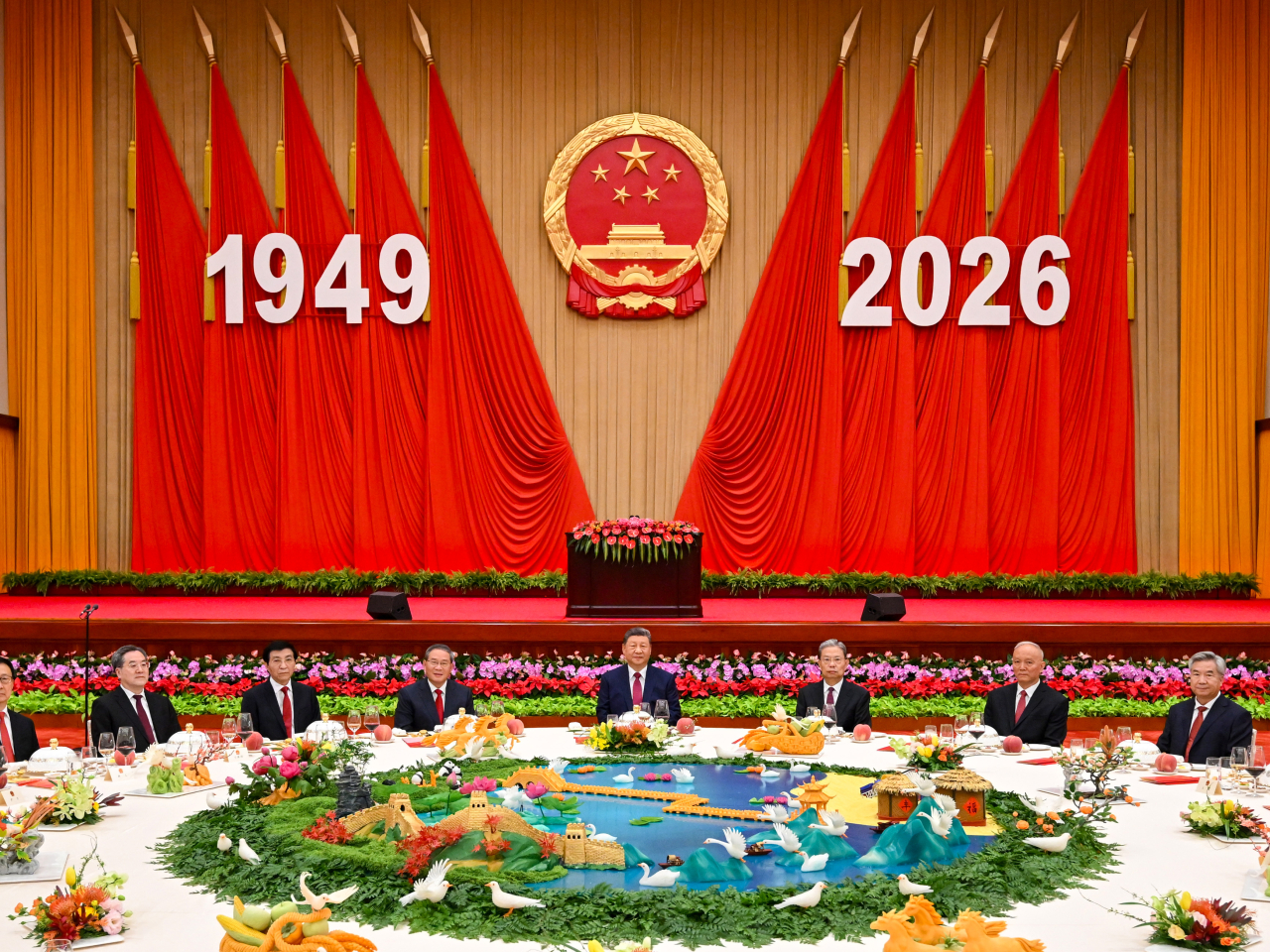
China’s President Xi Jinping called for steady economic progress, national unity and a stronger international role as he addressed a reception in Beijing marking the 77th anniversary of the founding of the People’s Republic of China. Speaking at the Great Hall of the People on Wednesday, Xi said China had continued to move forward despite economic and international pressures and urged the country to pursue its development goals with confidence and determination.
The reception came one day before China’s National Day on October 1. Xi, who is also general secretary of the Communist Party of China Central Committee and chairman of the Central Military Commission, used the annual event to outline the government’s priorities for the next stage of national development, including implementation of the 15th Five-Year Plan, economic growth, relations with Hong Kong and Macau, cross-Strait relations and China’s foreign policy.
Xi praises economic progress under pressure
Xi said China’s economy had continued to advance since the beginning of the year despite mounting pressure. He described the country’s economic performance as showing resilience while moving toward innovation-driven and higher-quality development.
The remarks come as China begins the first year of its 15th Five-Year Plan, which covers the period from 2026 to 2030. The plan sets out national economic and social development priorities for the next five years and has been presented by Chinese officials as an important framework for the country’s modernization drive.
Xi called for continued efforts to support economic development, improve people’s livelihoods and complete the targets set for the year. He also stressed the importance of maintaining progress while managing economic and domestic pressures.
China’s economic performance has remained closely watched by businesses and investors as the country works to maintain growth while shifting toward technology, advanced manufacturing and other higher-value sectors. Xi’s remarks therefore placed economic stability alongside innovation and improvements in living standards as major priorities for the government.
Earlier this month, Xi described the 15th Five-Year Plan as not only a blueprint for China’s own development but also a source of cooperation opportunities for other countries. At the BRICS summit in New Delhi, he said China would continue pursuing high-quality development, expanding high-standard opening and advancing international cooperation.
Hong Kong and Macau remain part of national strategy
Xi also reaffirmed Beijing’s commitment to the “One Country, Two Systems” framework governing Hong Kong and Macau.
He said China would continue implementing the principles of “Hong Kong people governing Hong Kong” and “Macao people governing Macao”, while maintaining a high degree of autonomy for the two special administrative regions.
Xi called for greater integration of Hong Kong and Macau into China’s broader national development. He also said Beijing would support the two regions in maintaining long-term prosperity and stability.
The remarks are consistent with the central government’s broader approach of linking the economic development of Hong Kong and Macau more closely with national development plans. The policy has been repeatedly discussed by Chinese leaders at National Day receptions and other major political events.
For Hong Kong, integration with the wider Chinese economy has included greater emphasis on the Greater Bay Area and closer links in areas such as finance, technology, infrastructure and trade. Macau has also been encouraged to diversify its economy and strengthen its role within wider national development strategies.
Xi repeats opposition to Taiwan independence
Taiwan was another major subject in Xi’s address.
He called for deeper exchanges and cooperation across the Taiwan Strait while reiterating Beijing’s opposition to forces advocating what China describes as “Taiwan independence” and to external interference.
Xi said China would continue promoting the peaceful development of cross-Strait relations while advancing what Beijing calls the cause of national reunification.
The Taiwan issue remains one of the most sensitive subjects in China’s relations with the United States and its regional partners. Beijing regards Taiwan as part of China and has repeatedly opposed moves toward formal independence. Taiwan’s government maintains its own political system and democratically elected authorities, while its leaders have rejected Beijing’s sovereignty claims.
By placing cross-Strait exchanges alongside opposition to separatism and outside interference, Xi again combined calls for engagement with a firm statement of Beijing’s position on sovereignty.
China stresses independent foreign policy
Xi also used the National Day reception to set out China’s approach to international affairs.
He said China would continue following an independent foreign policy of peace and would work to advance four major global initiatives associated with Beijing: the Global Development Initiative, Global Security Initiative, Global Civilization Initiative and Global Governance Initiative. He also reiterated China’s support for building a “community with a shared future for humanity.”
Xi said these efforts were intended to contribute greater certainty and what he described as positive energy to a world facing continuing instability and change.
China has increasingly presented these initiatives as part of its broader diplomatic agenda, particularly in its engagement with developing countries and the Global South. The Global Development Initiative, for example, was launched by Xi in 2021 and has since been promoted through international cooperation programmes.
At a high-level dialogue in New York this month marking the fifth anniversary of the Global Development Initiative, Chinese Vice President Han Zheng said more than 130 countries and international organisations supported the initiative and that more than 30 cooperation mechanisms and platforms had been established under it. Those figures reflect Beijing’s effort to expand the initiative's international reach, although participation and implementation vary across countries.
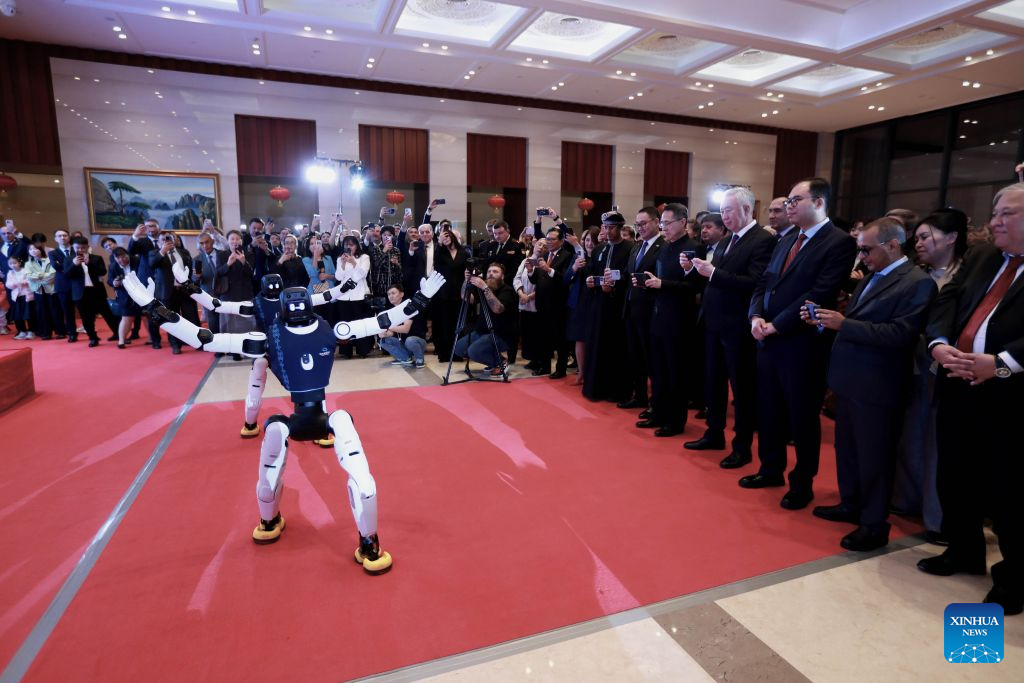
National Day reception brings together Chinese and foreign guests
The Great Hall of the People reception is an annual event held ahead of National Day and brings together senior Chinese officials, representatives from different sectors of Chinese society and foreign guests.
The event traditionally provides China's leadership with an opportunity to reflect on national development and outline priorities for the year ahead. Previous National Day receptions have similarly featured discussions of economic development, national unity, Hong Kong and Macau, cross-Strait relations and international cooperation.
This year’s gathering also comes during a period of heightened attention to China’s economic direction and international role. The launch of the 15th Five-Year Plan gives Beijing a new policy framework, while trade, technology, regional security and relations with major powers continue to shape the country’s external environment.
Xi’s speech connected those domestic and international issues rather than treating them as separate priorities. Economic development, national unity and foreign policy were presented as parts of a wider programme centred on China’s long-term modernization.
A message focused on continuity and development
Xi’s address did not announce a major change in China’s established policy positions. Instead, it reinforced several themes that have featured repeatedly in recent speeches: economic development, technological innovation, improving living standards, national unity, opposition to Taiwan independence, support for the “One Country, Two Systems” framework and an expanded Chinese role in international cooperation.
The timing of the speech also carries significance. China is entering the first year of its new five-year development plan, while Beijing is seeking to maintain economic momentum amid domestic and international pressures.
For businesses, regional governments and foreign partners, the emphasis on innovation, high-quality development and international cooperation points toward the areas Beijing intends to prioritise during the new planning period.
For observers of China’s foreign policy, the continued references to Taiwan, Hong Kong, Macau and the four global initiatives provide a clear indication that these issues will remain central to Beijing’s domestic and diplomatic agenda.
As China prepares to mark National Day on October 1, Xi’s message was centred on maintaining economic progress, strengthening national development and continuing the policies that Beijing says are intended to advance modernization. The immediate test will be how those priorities translate into economic targets, regional policies and international cooperation during the opening year of the 2026–2030 Five-Year Plan.
How do you think China’s new five-year development plan could shape its economy and international role over the next five years?