

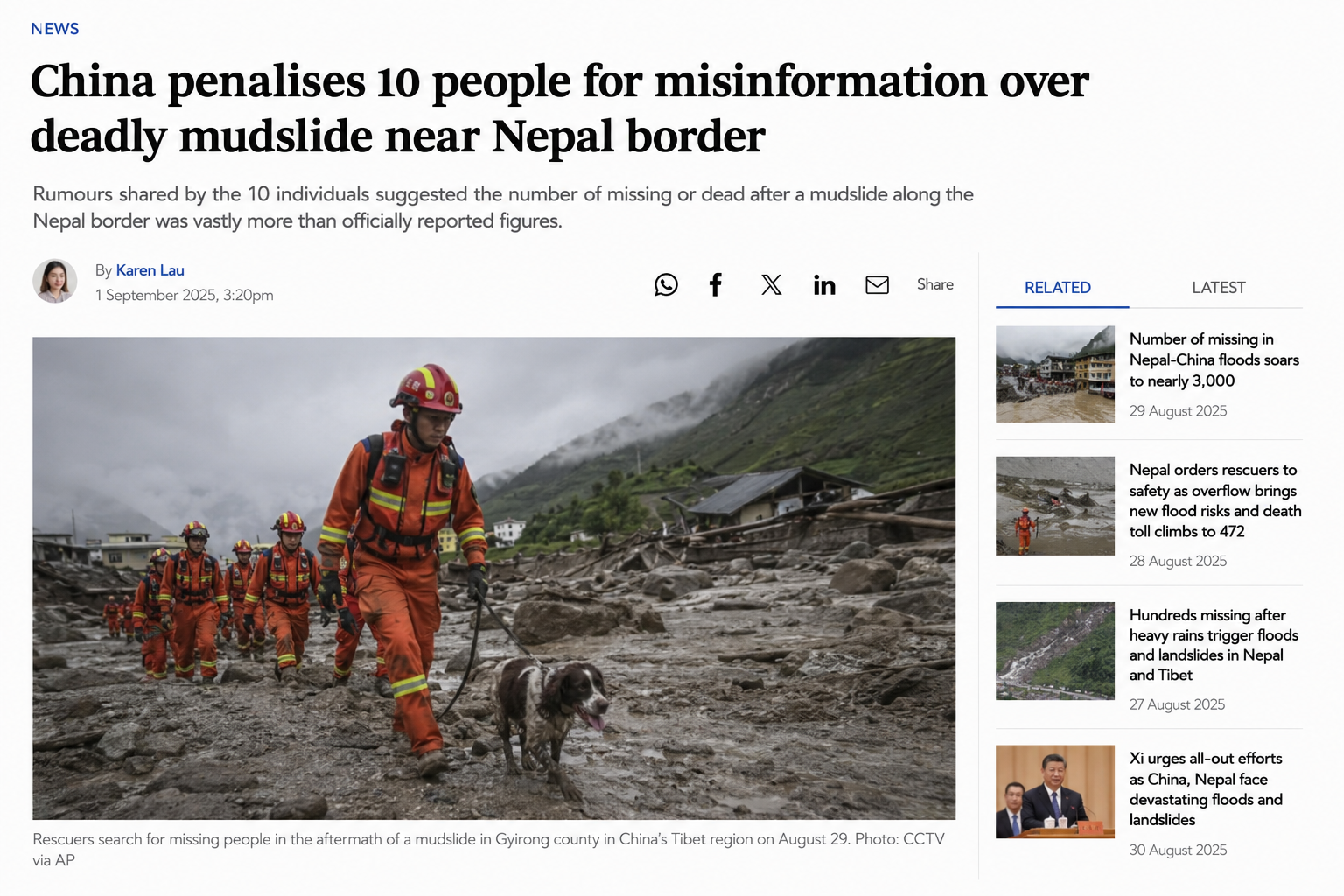
Chinese authorities have penalised 10 people accused of spreading misinformation online about a deadly mudslide near the country's border with Nepal, as emergency crews continue searching for hundreds of people still missing in one of the worst affected areas on the Tibetan side.
The penalties were announced on Monday as rescuers worked through unstable terrain, thick mud and damaged roads following severe flooding and landslides that struck parts of Nepal and China's Tibet region last week.
China's Ministry of Public Security said the 10 individuals had circulated claims that significantly exaggerated the number of people killed or missing in the disaster. Authorities said the posts had caused concern and spread false information at a time when rescue operations were still under way.
The exact penalties imposed on each person were not disclosed. Under Chinese law, such measures can include fines or detention of up to 10 days, depending on the circumstances.
The announcement came as questions continued to circulate online and internationally about the scale of the disaster, particularly in Tibet, where access for foreign journalists is heavily restricted.
According to the ministry's cybersecurity bureau, one person identified by the surname Qiu posted online that news reports had put the death toll at 1,400 but claimed that 3,000 people had already been reported missing.
Another individual, surnamed Liu, allegedly claimed that more than 3,000 people had died in China as a result of the mudslide.
Chinese authorities said those figures were false.
Hundreds remain missing
The disaster has caused extensive damage on both sides of the Nepal China border.
Nepal's disaster authority says at least 903 people have died, while another 4,247 remain missing. The scale of the missing persons figure reflects the difficulty of determining the fate of people swept away by floodwaters or trapped in isolated communities.
On the Chinese administered side of the border, 16 people have died and 546 remain missing, according to the figures cited by authorities.
The mudslide struck an area of Tibet covering about 0.7 square kilometres, according to Chinese state media. That is roughly equivalent to the area covered by 98 football pitches.
The hardest hit area in Tibet is Gyirong county, a mountainous border region that includes the Gyirong port crossing used for travel and trade between China and Nepal.
The geography has made the rescue operation particularly difficult. Emergency crews are working in high altitude conditions, with steep valleys, unstable slopes and changing weather complicating efforts to reach affected communities.
China's official Xinhua news agency reported on Monday that emergency workers were racing to locate survivors and people who remained trapped or unaccounted for.
Crews were working inside what authorities described as the core disaster area, clearing mud from roads and searching damaged settlements. They were also inspecting areas for additional hazards, disinfecting affected locations and repairing routes damaged by the floods and landslides.

Questions over information from Tibet
The announcement of penalties against the 10 people came amid criticism from outside China over the availability of information about the disaster.
Tibet is an autonomous region of China, but access for foreign journalists is tightly controlled. That makes independent verification of casualty figures and damage particularly difficult, especially in remote areas close to the Nepal border.
International reports have raised questions about whether images and information concerning the floods were being restricted online and whether the number of deaths was being fully reported.
China's Foreign Ministry rejected those suggestions on Monday.
Foreign Ministry spokesperson Guo Jiakun said information about the disaster had been released in an “open, transparent and timely” manner.
He also criticised what he called “malicious smearing and sensationalism” involving the disaster, saying such claims would not gain public support.
The exchange reflects a wider dispute over how information is reported during major disasters in areas where access is limited. Chinese authorities have emphasised official casualty figures and warned against the circulation of unverified claims, while outside observers have pointed to the difficulty of independently checking reports from Tibet.
Rescuers face difficult conditions
On the ground, rescue teams have been dealing with conditions that could change quickly.
State broadcaster CCTV showed emergency workers accompanied by sniffer dogs moving through debris in valleys affected by the mudslide. Other footage showed rescuers wading through deep mud and crews working to restore electricity.
The work involves more than searching for survivors. Teams are removing mud from roads, checking slopes for further dangers, disinfecting affected areas and attempting to restore transport routes damaged by the disaster.
The weather remains a concern.
A forecaster with China's National Meteorological Center said on Sunday that Gyirong county was expected to receive some rainfall in the following days. Rain could make already damaged roads slippery and create additional problems for rescue teams operating on steep mountain routes.
The risks were demonstrated by the formation of a new lake after a landslide blocked an area near the border crossing.
Workers in the vicinity of the port were moved to safety on Sunday because of concerns over rising water and the possibility of another flood.
Chinese emergency authorities later said the lake had naturally overflowed and had largely emptied.
The development reduced the immediate threat from the newly formed body of water, but rescue crews continued to face unstable ground and damaged infrastructure across the affected area.
Communication services have also been disrupted by the disaster. Xinhua reported on Sunday night that communications had been restored at Gyirong port, providing an important link for emergency coordination and information from the border area.
Foreign nationals among the missing
The disaster has also affected people from outside China.
Of the 546 people reported missing in Tibet, 261 were foreign nationals, according to Chinese authorities.
Those missing include 104 Nepalese nationals, 49 Indians, 33 people from Latvia and 18 Americans.
The figures underline the international nature of the border area, where workers, traders, travellers and other visitors regularly move between Nepal and China.
The Gyirong crossing is an important route between the two countries, particularly because the mountainous frontier has relatively few accessible crossings.
The presence of hundreds of missing foreign nationals is also likely to increase attention from governments and families seeking information about those caught in the disaster.

Nepal's death toll continues to rise
The destruction in Nepal has been even more extensive.
At least 903 people have died and 4,247 remain missing, according to Nepal's disaster authority. Floodwaters and landslides have affected villages, roads and other infrastructure, leaving emergency workers facing major logistical challenges.
The disaster has also created fresh dangers for rescuers. Authorities in Nepal ordered some rescue workers to move to safer locations after the formation of an overflow area raised concerns about additional flooding.
The shared disaster across the border has required emergency operations in difficult mountain terrain on both sides.
While Chinese authorities have focused heavily on the search in Tibet, Nepalese agencies have continued their own recovery and search efforts amid a large number of people still unaccounted for.
Xi orders continued search
Chinese President Xi Jinping said on Monday that the country was making every effort to find people who remained missing on the Chinese side of the border.
His statement came as rescue teams continued working through the affected area and as authorities sought to restore roads, communications and power supplies.
The search is likely to remain difficult because of the terrain and weather. Mountain roads can become impassable quickly, while further rainfall could loosen debris and create new hazards for teams already working in unstable areas.
For families waiting for news, the official figures provide a measure of the disaster but not yet an answer about what happened to hundreds of missing people.
The immediate task for rescuers remains clear: reach isolated areas, search the debris and establish the whereabouts of those still unaccounted for while conditions remain safe enough for crews to continue.