

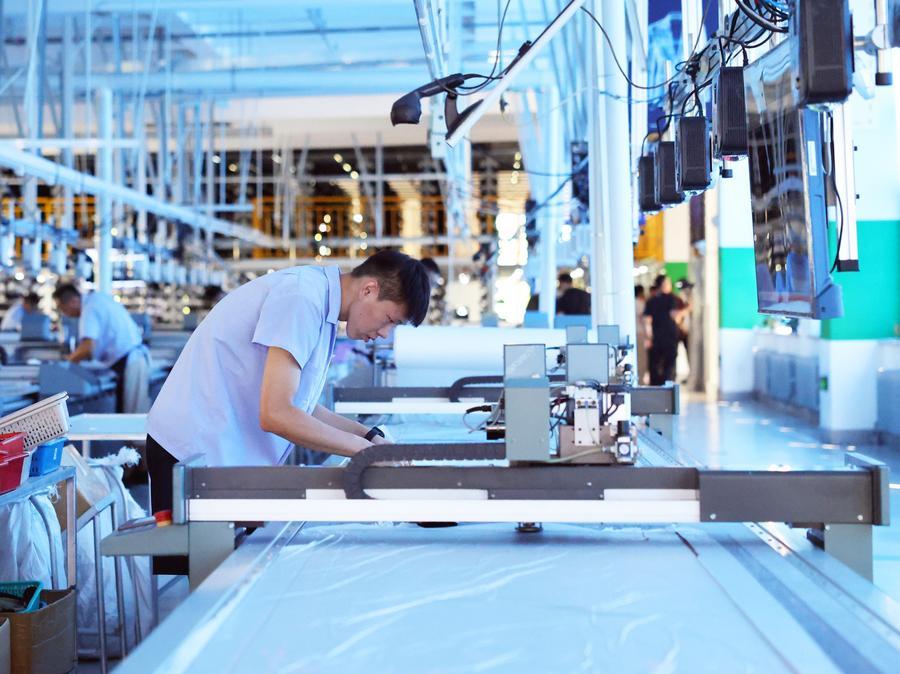
China's industrial production accelerated in August, driven by strong gains in high technology manufacturing, equipment production and a sharp rise in industrial robot output, according to official data released Tuesday.
Value added industrial output increased 5.2 percent year on year in August, 0.7 percentage point higher than the growth recorded in July, the National Bureau of Statistics said. The figures point to stronger activity across several technology intensive parts of the economy even as property investment and overall fixed asset investment remained under pressure.
High technology manufacturing recorded one of the strongest performances, with output rising 16.7 percent from a year earlier. Equipment manufacturing increased 12.1 percent. Both sectors expanded considerably faster than overall industrial production, exceeding the national industrial growth rate by 11.5 and 6.9 percentage points respectively.
The gains were particularly pronounced in several products linked to automation, advanced manufacturing and the broader shift towards technology based production.
Industrial robot output rose 34.6 percent year on year in August. Production of lithium ion batteries increased 57.2 percent, while output of 3D printing equipment climbed 29.9 percent.
Those figures offer a closer look at where China's manufacturing expansion is concentrated. Rather than relying solely on traditional heavy industry, factories are increasingly producing equipment and components connected with automation, digital manufacturing, energy storage and other technology driven industries.
Industrial Robots Spread Across More Industries
The rapid rise in robot production comes as Chinese made industrial robots are being used across an expanding range of industries.
Data released in July by the China Machinery Industry Federation showed that domestic industrial robots were being used in 253 industry groups. That represents more than half of all industry groups in China.
The wider use of automation reflects changes taking place inside Chinese factories, where manufacturers are seeking greater production efficiency while expanding their capacity to make increasingly sophisticated products.
Robot production is also closely linked to other areas of industrial growth. Demand for automated machinery can rise as manufacturers expand battery production, electronics manufacturing, vehicle production and other technology intensive operations.
The August figures suggest that this process is continuing. Industrial robot output increased by more than one third compared with the same month a year earlier, putting automation among the fastest growing areas of China's industrial economy.
Manufacturing Leads While Mining Contracts
The overall industrial figures also show a clear difference between major sectors.
Mining value added output fell 1.4 percent year on year in August. Manufacturing, by contrast, expanded 6.1 percent.
The electricity, heat, gas and water production and supply sectors recorded growth of 4.9 percent.
The figures indicate that manufacturing remained the main source of industrial expansion, while the mining sector faced weaker output. That contrast is significant for an economy that has spent years shifting towards higher value manufacturing and technology intensive production.
By ownership, state owned and state holding enterprises recorded 3 percent year on year growth in value added output. Private enterprises grew 3.7 percent.
Across the first eight months of 2026, China's industrial output increased 5.3 percent year on year.
That performance provides a broader measure of factory activity beyond the stronger August result and shows that industrial production has maintained a relatively steady pace through the year.
New Growth Drivers Gain Ground
Fu Linghui, a spokesperson for the National Bureau of Statistics, said industrial production remained stable in August despite fluctuations in international energy and raw material markets.
He attributed the performance partly to efforts to secure energy supplies and advance the country's green transition.
Fu also pointed to continued growth in emerging industries, saying technological innovation and industrial development were becoming increasingly integrated. New growth drivers contributed more than 60 percent of the increase in industrial output, according to his remarks at a press conference on Tuesday.
The manufacturing purchasing managers' index stood at 49.8 in August. Although a reading below 50 indicates contraction in manufacturing activity under the index's methodology, the index measuring companies' expectations for future production and business activity reached 53.8.
That expectations figure indicates that businesses continued to express confidence in their production and operating prospects.
Corporate earnings have also provided support. From January through July, total profits at China's major industrial companies reached 4.58 trillion yuan, equivalent to about $677.12 billion, representing a 17.6 percent increase from the same period a year earlier.
The industrial output figures cover large enterprises with annual main business revenue of at least 20 million yuan.
Consumer Demand Remains More Moderate
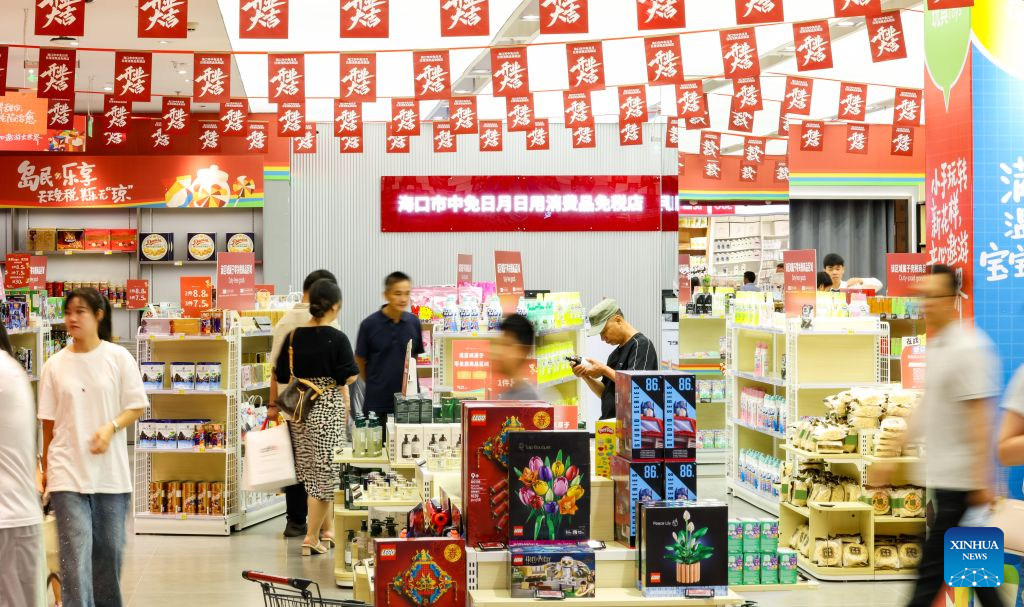
The latest data also provide a picture of China's domestic consumption, where growth has been more restrained than in some technology manufacturing segments.
Total retail sales of goods and services increased 2.5 percent year on year during the first eight months of 2026.
Services performed better than goods during the period. Retail sales of services increased 4.9 percent year on year, compared with 1 percent growth in goods sales.
Communication and information services, tourism consulting and rental services, as well as cultural, sports and leisure services recorded relatively strong growth.
Retail sales of consumer goods, including goods sales and catering revenue, reached 32.76 trillion yuan in the first eight months, an increase of 1.1 percent from the same period last year.
Online commerce continued to provide an important source of sales. Online retail sales of goods and services reached 13.48 trillion yuan, up 4.6 percent year on year.
Online sales of goods increased 4.3 percent to 8.42 trillion yuan, while online service sales rose 5.1 percent to 5.06 trillion yuan.
In August alone, retail sales of consumer goods reached 3.98 trillion yuan, an increase of 0.4 percent year on year.
The difference between industrial and consumer growth remains notable. Advanced manufacturing is expanding at a much faster pace than household spending, while policymakers continue to seek stronger domestic demand.
Fixed Asset Investment Under Pressure
Investment data presented a weaker picture.
China's fixed asset investment fell 7.2 percent year on year during the first eight months of 2026, with total investment during the period standing at about 29.3 trillion yuan.
Even when the property sector was excluded, fixed asset investment declined 4.2 percent.
The figures show that investment remains an area of weakness despite strong expansion in selected high technology industries.
There were, however, significant differences between sectors.
Investment in intellectual property products increased 9.2 percent year on year. Investment in high technology industries rose 5.2 percent.
Within high technology industries, investment in information services increased 22.7 percent. Aerospace and spacecraft manufacturing investment rose 14.9 percent, while investment in electronic and communication equipment manufacturing increased 6.9 percent.
Those figures reinforce the pattern visible in industrial production. Investment is increasingly flowing towards selected technology related activities even as broader investment remains under pressure.
By industry, investment in the primary sector fell 2.4 percent year on year during the first eight months. Investment in the secondary sector declined 2.9 percent, while investment in the tertiary sector dropped 9.9 percent.
Infrastructure investment decreased 4 percent, manufacturing investment fell 2.3 percent and real estate development investment recorded the sharpest decline, falling 19.9 percent.
Property Market Shows Signs of Easing Declines
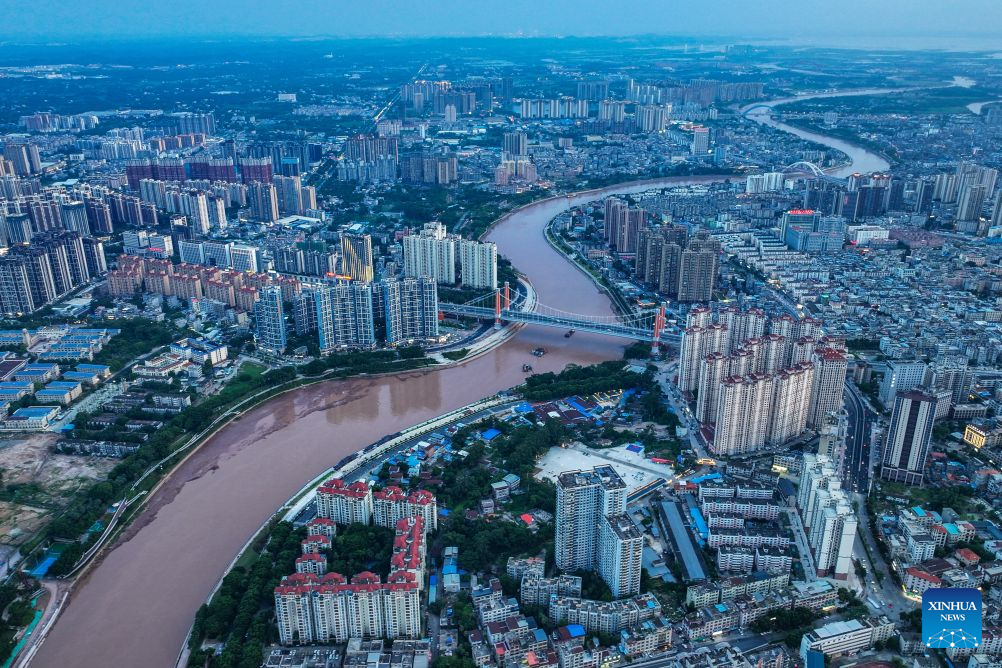
The property market continued to weigh on investment, although official figures showed that annual home price declines became narrower in August across many major cities.
In the four first tier cities of Beijing, Shanghai, Guangzhou and Shenzhen, new home prices fell 0.9 percent year on year. The decline was 0.2 percentage point narrower than in July.
Second hand home prices in the same four cities declined 2.7 percent year on year, an improvement from the 3.7 percent decline recorded in July.
Second and third tier cities also reported smaller annual declines in both new and second hand home prices compared with the previous month.
Monthly figures provided some additional signs of improvement. New home prices in first tier cities rose in August, while second and third tier cities generally recorded smaller monthly declines.
Across the 70 large and medium sized cities monitored by the National Bureau of Statistics, 21 recorded either stable or higher new home prices in August compared with July. That was two fewer cities than in the previous month.
For second hand homes, eight cities recorded either stable or higher prices month on month, unchanged from July.
The monthly property report covers 70 cities, consisting of four first tier cities, 31 second tier cities and 35 third tier cities.
Technology Becomes a Larger Part of Industrial Growth
Taken together, the August figures show an economy with sharply different sources of momentum.
Traditional areas such as mining and property investment remain under pressure, while advanced manufacturing, automation, batteries, aerospace and communications equipment are recording stronger growth.
Industrial robots provide one of the clearest examples. Their output rose 34.6 percent in August as domestic manufacturers expanded their use across hundreds of industry groups.
Lithium ion battery production rose even faster, increasing 57.2 percent, while 3D printing equipment output climbed 29.9 percent. These figures point to continued expansion in sectors connected with electrification, automation and advanced production.
At the same time, household consumption is growing at a slower pace and fixed asset investment remains weak.
For policymakers and businesses, the next question is whether the strength of technology manufacturing can continue to offset weakness in property and broader investment while domestic consumption gathers more momentum.
The August data provide one clear answer: China's industrial expansion is increasingly being driven by factories making the technologies that are reshaping production itself. As industrial robots, batteries and advanced equipment take a larger role in the economy, how quickly can consumer demand and private investment catch up?