

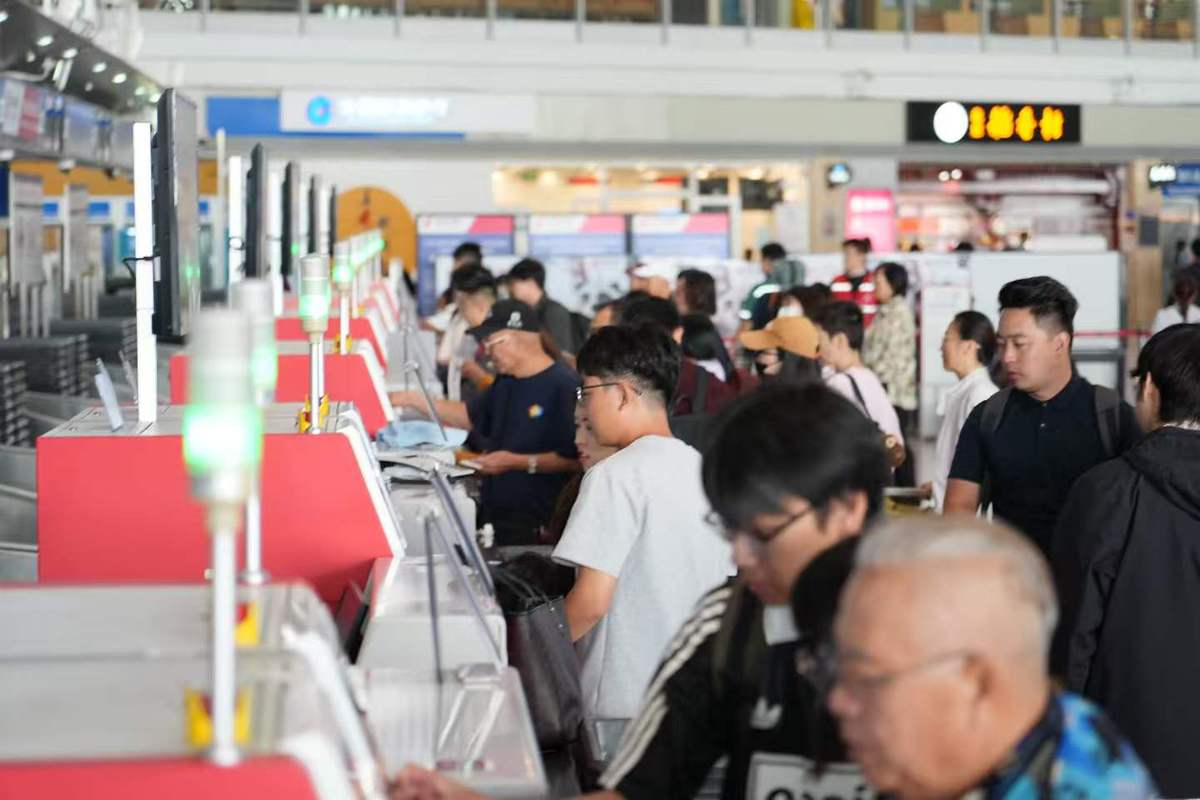
China's airports are preparing for one of the busiest National Day travel periods on record, with millions of passengers expected to take domestic and international flights during the extended holiday.
The country's civil aviation sector is expected to handle 31.19 million passenger trips from Sept 25 to Oct 7, with daily traffic averaging about 2.4 million passengers, according to Ma Bing, deputy head of the Civil Aviation Administration of China. The figure represents a 3.6 percent increase from the same period last year.
Daily passenger numbers could exceed 2.6 million at the busiest points of the travel period, putting airports and airlines under pressure to manage large crowds, dense flight schedules and strong demand for overseas destinations.
The National Day holiday officially begins on Thursday and lasts seven days, but the wider travel period covers several days before and after the holiday as passengers leave cities early and return home at the end of the break.
Beijing Capital International Airport is preparing for particularly heavy traffic. The airport expects to handle more than 1.66 million passenger trips during the holiday, averaging about 237,000 passengers a day.
It has scheduled 9,448 flights during the period, equivalent to roughly 1,350 flights each day.
Passenger numbers at the airport are expected to reach their highest levels on Oct 1 and Oct 7, when traffic could exceed 245,000 trips on each day.
International travel gains momentum
International travel is emerging as one of the strongest areas of growth during this year's holiday period.
Bookings for international trips have increased 22.5 percent year on year, according to the figures released by Chinese aviation authorities.
Shorter international routes are seeing particularly strong demand. Flights connecting China with Thailand, Malaysia, Vietnam and Laos have increased by about 20 percent compared with the same period last year.
Demand is also rising on longer European routes. Flights to the United Kingdom, Germany and Spain have increased by about 15 percent.
The growth reflects continued demand for overseas holidays as travelers use the National Day break to visit destinations outside mainland China.
Bangkok, Singapore, Ho Chi Minh City and Bali are among the most popular international destinations expected to attract Chinese travelers during the holiday.
The increase in international traffic also comes as airlines continue to expand or restore services on routes serving major tourism and business centers across Asia and Europe.
For airports, that means the holiday rush will not be limited to domestic terminals. International departure halls are also expected to experience heavier passenger volumes as travelers arrive for check in, security screening and immigration procedures.
Domestic destinations remain busy
Domestic travel continues to account for a large share of holiday demand.
The most popular destinations include Shanghai, Guangzhou, Shenzhen, Chengdu, Chongqing and Guiyang. These cities combine large populations, established transport networks and strong tourism demand, making them frequent choices during major public holidays.
Average daily bookings at China's 10 major aviation hubs have exceeded 490,000, representing a 3.9 percent increase compared with the same period last year.
The growth is not confined to China's largest cities.
Several destinations known for seasonal scenery and outdoor tourism are recording much sharper increases in passenger traffic.
Hulunbuir in the Inner Mongolia autonomous region, Dehong in Yunnan province and Altay in the Xinjiang Uygur autonomous region have all seen traffic increases of more than 30 percent.
The rise in demand suggests that travelers are continuing to look beyond the country's biggest urban centers during the holiday. Smaller and regional destinations with distinctive landscapes, cooler weather or seasonal attractions are attracting a growing share of holiday visitors.
For local airports, a 30 percent or greater increase can create significant operational demands even when total passenger numbers remain below those at Beijing, Shanghai or Guangzhou.
Beijing airports prepare for heavy flows
Beijing's two major airports are preparing for separate waves of passengers during the holiday period.
Beijing Capital International Airport expects more than 1.66 million passenger trips during the seven day National Day break. Its schedule of 9,448 flights is designed to accommodate the expected increase in demand.
Oct 1 is expected to be one of the busiest days as travelers begin their holiday journeys. Passenger numbers are forecast to exceed 245,000 at Capital Airport that day.
Oct 7 is expected to produce another major surge as travelers return to Beijing and other cities before work and school resume.
Beijing Daxing International Airport is also preparing for high passenger volumes during the broader travel period.
The airport expects to handle 11,040 flights and about 1.79 million passenger trips. Its busiest day is forecast to be Oct 1, when approximately 180,000 passenger trips and 1,150 flights are expected.
The figures show the scale of air travel expected across the capital during the holiday period. With both airports operating extensive schedules, Beijing will be one of the country's main gateways for travelers moving between domestic and international destinations.
Airlines and airports face concentrated demand
The National Day holiday creates a predictable pattern for China's transport system. Large numbers of people leave major cities at roughly the same time, while return traffic builds toward the end of the break.
Airlines therefore have to manage passenger demand alongside aircraft rotations, airport capacity and flight schedules.
The expected daily national average of 2.4 million passenger trips is already high, but the forecast of more than 2.6 million passengers on peak days will put additional pressure on airport facilities.
For passengers, the busiest days are likely to involve longer queues at check in counters, security checkpoints and boarding gates, particularly at major hubs.
Travelers heading overseas may also need additional time for immigration procedures and other departure formalities.
The growth in international bookings means some passengers will be traveling on routes that are considerably longer than domestic holiday journeys. Popular Asian destinations are expected to account for much of the international traffic, while European routes are also recording significant growth.
Holiday travel reaches new levels
The expected 31.19 million passenger trips between Sept 25 and Oct 7 point to a strong period for China's aviation industry.
The 3.6 percent year on year increase is notable because the overall passenger total is already expected to reach a record level.
Domestic aviation remains the foundation of the holiday rush, with major cities continuing to attract large numbers of visitors. At the same time, the sharp rise in international bookings is changing the mix of travel demand.
The strongest increases are being recorded on routes to neighboring Asian countries and selected European destinations.
Regional tourism centers are also gaining from the holiday, with several destinations outside China's largest cities reporting passenger growth of more than 30 percent.
As airports prepare for the busiest days, passengers can reduce delays by checking flight information before leaving for the airport, allowing extra time for security and arriving early for international departures.
With more than 2.6 million passenger trips potentially concentrated into peak travel days, travelers should plan their airport journey carefully and check the latest flight information before setting out.
Where are you traveling during China's National Day holiday, and what steps will you take to avoid the busiest airport periods?